
Events › Soviet-Afghan War › Last Soviet Troops Cross the Friendship Bridge Out of Afghanistan
Last Soviet Troops Cross the Friendship Bridge Out of Afghanistan
Record status: submitted, awaiting review · version 2 · record history
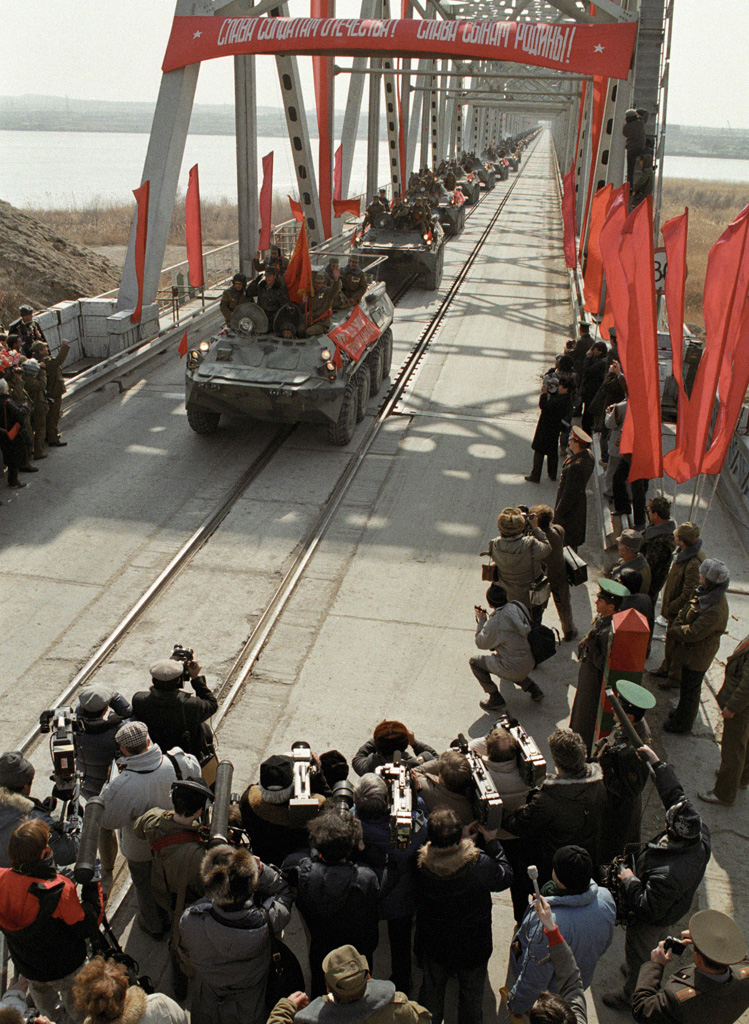
A convoy carried the last 200 Soviet soldiers out because the deadline to leave had arrived. It happened on February 15, 1989. This crossing was part of the Soviet-Afghan War, a war in which Soviet troops fought with Afghanistan’s communist government against Afghan rebels; the war began in December 1979 and ended that February. The soldiers left by the Friendship Bridge, a long steel bridge over a border river between Afghanistan and the Soviet Union.
The Soviet Union, a huge communist country led from Moscow, had been stuck in a long fight against the Mujahidin, Afghan Muslim fighters who fought the Soviet troops and the Afghan government they backed. The Geneva agreements, signed in Geneva by Afghanistan, Pakistan, the United States, and the Soviet Union, set a timetable for all Soviet soldiers to leave. Soviet leaders had agreed to bring their troops home.
Because that deadline had arrived, the last Soviet units gathered at the bridge. A convoy of 15 vehicles crossed first, carrying the last 200 soldiers based in Afghanistan. Monitors counted the soldiers as they crossed. Then Boris Gromov, the Soviet general who commanded the troops at the end, crossed the bridge and stood at attention at the Soviet border marking because he had pledged to be the last Soviet soldier out.
Gromov told reporters that his first thoughts were of joy that the Soviet forces had fulfilled their international duty and come home. With Gromov’s crossing, no Soviet troops remained in Afghanistan. The withdrawal was complete on the date the agreement required, and the Soviet part in the war was over.
This is one part of Soviet-Afghan War.
When
Sometime on February 15, 1989.
- What the source says
- Lieutenant General Boris Gromov crossed the Friendship Bridge across the Amu Darya river into Soviet Uzbekistan at midday on February 15 (Al Jazeera, 2009)
- Written for the computer as
1989-02-15(Gregorian calendar, UTC; years at or below zero are BC: −0005 is 6 BC)- How sure
- exact, to the day
- Worked out by
- the Chronum server, method
edtf_gregorian_utcversion 1: the period lies within the written day
History Snippet never shows a single "best guess" date. The bar is the whole span the evidence allows; the hatched part means "somewhere in here". Why.
How we know
Took place at: Boris Gromov, the last Soviet commander in Afghanistan, walked across the Friendship Bridge into Soviet territory on the day of the pullout's end, a Wednesday (February 15, 1989).
Claim status: submitted, awaiting review
- supports With a tearful word of remembrance and a brief..., Opening paragraph (dateline Termez, U.S.S.R.)
Boris Gromov walked across the Friendship Bridge into Soviet territory Wednesday
Preceded by: Minutes before Gromov crossed, a convoy carrying the last 200 soldiers based in Afghanistan crossed the bridge to Soviet soil.
Claim status: submitted, awaiting review
- supports With a tearful word of remembrance and a brief..., Body of article, paragraph on the convoy
a 15-vehicle convoy carrying the last 200 soldiers based in Afghanistan crossed to the safety of Soviet soil
Occurred at time: Gromov crossed the Friendship Bridge over the Amu Darya river into Soviet Uzbekistan at midday on February 15.
Claim status: submitted, awaiting review
- supports Russia marks Afghanistan retreat, Opening section
crossed the Friendship Bridge across the Amu Darya river into Soviet Uzbekistan at midday on February 15
Took place at: The commander of the Soviet forces in Afghanistan, Boris Gromov, crossed the Termez Bridge out of Afghanistan on February 15, 1989, which marked the end of the Soviet war.
Claim status: submitted, awaiting review
- supports Afghanistan and the Soviet Withdrawal 1989: 20 Years Later, Introduction, posted February 15, 2009
the commander of the Soviet Limited Contingent in Afghanistan Boris Gromov crossed the Termez Bridge out of Afghanistan
Described as: Gromov was greeted on the Soviet side by television cameras and given a bouquet of red carnations; he was officially the last Soviet soldier to leave.
Claim status: submitted, awaiting review
- supports How to Build Putin a Gilded Bridge Out of Ukraine, Opening paragraph
Soviet General Boris Gromov walked across the Friendship Bridge from Afghanistan into the Soviet Union
Disputed staging: One account says the exit was staged: Gromov spent the previous night in the Soviet Union and came to Afghanistan only to cross the bridge for the cameras.
Claim status: submitted, awaiting review
- supports How to Build Putin a Gilded Bridge Out of Ukraine, Opening paragraphs
traveled to Afghanistan only to stage the exit
Caused by: The Geneva Accords set a timetable under which all Soviet forces were to be removed by February 15, 1989, which is why the crossing happened that day.
Claim status: submitted, awaiting review
- supports Afghanistan - The Geneva Accords, 1987-89, Section 'The Geneva Accords, 1987-89', opening paragraph
according to a timetable that would remove all Soviet forces by February 15, 1989
Sources disagree: Sources agree on the date and the bridge, but differ on how he crossed: one report says he rode partway on an armored vehicle, and another says the exit was staged after a night spent in the Soviet Union.
Claim status: submitted, awaiting review
Where
Friendship Bridge over the Amu Darya river, between Hairatan, Afghanistan, and Termez, Soviet Uzbekistan
- Coordinates
- 37.2600, 67.3100 (modern map coordinates)
- Error distance
- the true spot could be up to 3,000 m from those coordinates (3.0 km)
- Today this spot lies in
- Uzbekistan
Borders shown are today's; the record says where the place is on the modern map, not what country ruled it then.
Who and what
Pictures
Record history
Every change is a new version; older versions stay readable forever.
- Version 2 · 2026-11-21 17:32 UTC · submitted, awaiting review
published after review of the private record