
Events › October Revolution
October Revolution
Record status: submitted, awaiting review · version 3 · record history
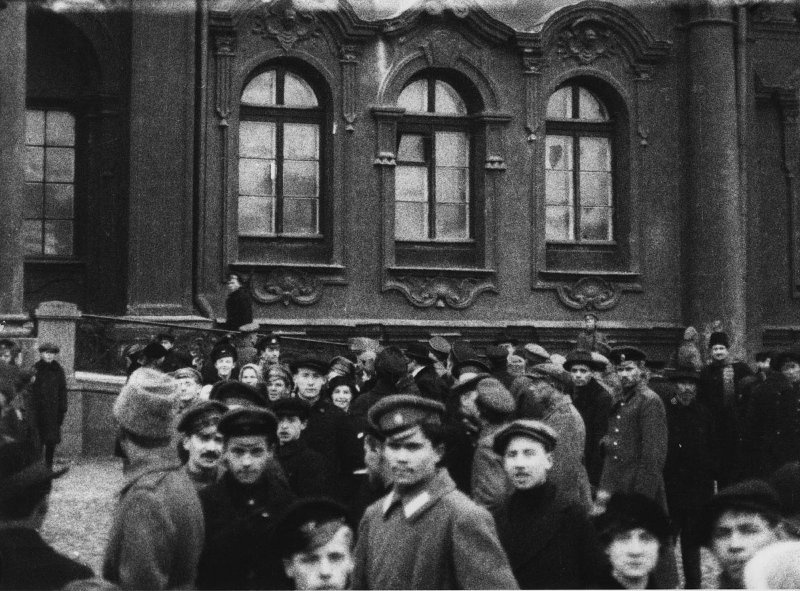
On the night of November 7, 1917, to November 8, 1917, Red Guards, armed workers and soldiers, broke into the Winter Palace, the huge former home of Russia’s tsars where the temporary government met. They arrested the ministers who ran that government. This was the October Revolution in Petrograd, the capital of Russia in 1917, now called Saint Petersburg. It began and ended in November 1917.
Russia had been ruled by the Provisional Government, the temporary government that took over after the tsar lost the throne in 1917. But that government lost almost all support because Russian soldiers kept dying in World War I, a huge war in which Russia fought Germany and others. The Bolsheviks, a Russian revolutionary party led by Vladimir Lenin that wanted workers and soldiers to rule, wanted power to pass to the Soviets, councils of elected workers, soldiers and peasants.
During 1917, the Provisional Government grew weaker as the war kept killing more soldiers. By September 1917, the Bolsheviks had taken control of the council of workers’ and soldiers’ representatives in Petrograd. In late October 1917, Lenin decided the time had come to seize power in the name of the Soviets because divisions inside the Provisional Government were growing.
Because Lenin and other Bolshevik leaders had decided to take power, the Red Guards moved on the night of November 6, 1917. They took important places in Petrograd, including railway stations and telegraph offices. By the evening of November 7, 1917, the Bolsheviks held the whole city except the Winter Palace. The ministers could find almost no one willing to defend them.
The Winter Palace was the last place the Provisional Government held in Petrograd, so the Red Guards broke in and arrested the ministers. On November 7, 1917, the Bolsheviks announced that the government had fallen, and Alexander Kerensky, the leader of the Provisional Government, left Petrograd to join troops. The Bolsheviks took power in Russia, but overthrowing the government was only the first step. Over the next three years, they fought a war between groups inside Russia to keep power across the country.
Inside this event
When
Sometime in November 1917.
- What the source says
- November 6-7, 1917 (or October 24-25, 1917, by the Julian calendar, which was then in use in Russia)
- Written for the computer as
1917-11(Gregorian calendar, UTC; years at or below zero are BC: −0005 is 6 BC)- How sure
- approximate, to the month
- Worked out by
- the Chronum server, method
edtf_gregorian_utcversion 1: the period lies within the written month
History Snippet never shows a single "best guess" date. The bar is the whole span the evidence allows; the hatched part means "somewhere in here". Why.
How we know
Began on: The revolution is dated November 6-7, 1917 by the modern calendar, which is October 24-25 by the Julian calendar then used in Russia. Bolshevik troops occupied key points in Petrograd on the night of November 6.
Claim status: submitted, awaiting review
- supports Bolsheviks Mount the October Revolution, Opening summary and date line
on the night of November 6, Bolshevik troops occupied key points in Petrograd and isolated the Winter Palace
Took place at: Ministers of the Provisional Government were arrested inside the Winter Palace in Petrograd on the night of October 25 (November 7), 1917, by a group of soldiers and sailors under Vladimir Antonov-Ovseyenko.
Claim status: submitted, awaiting review
- supports The Winter Palace and the Hermitage in 1917, Exhibition description
arrested members of the Provisional Government in the Small Dining-Room of the Winter Palace.
Caused by: The Provisional Government had lost almost all support as Russia's heavy casualties in World War I kept growing.
Claim status: submitted, awaiting review
- supports The October Revolution in Russia, Opening paragraphs
but it had lost almost all support as Russia’s horrific World War I casualties continued to mount.
Ended on: Red Guards broke into the Winter Palace and arrested the ministers, which ended the Provisional Government. This was the climax of the takeover in Petrograd.
Claim status: submitted, awaiting review
- supports The October Revolution in Russia, Opening paragraphs
Bolshevik Red Guards broke into the palace and arrested the ministers, bringing the Provisional Government to an end.
Resulted in: Overthrowing the government was followed by about three years of civil war, in which the Bolsheviks had to win and keep power.
Claim status: submitted, awaiting review
- supports The October Revolution in Russia, Closing paragraph of the opening summary
would have to win power in a bloody civil war
Resulted in: On November 7, 1917 the US ambassador reported that the Bolsheviks controlled Petrograd and that Trotsky said the Provisional Government no longer existed.
Claim status: submitted, awaiting review
- supports Historical Documents - Office of the Historian (Foreign Relations of the United States, 1918, Russia, Volume I), Chapter V, The November Revolution, telegram list for Nov. 7
Trotsky asserts Provisional Government no longer exists.
Caused by: Lenin judged that the moment had come to take power in the name of the Soviets, as divisions grew inside the Provisional Government.
Claim status: submitted, awaiting review
- supports A Brief History of the Russian Revolution, Section on 1917
Lenin realised this was the time to take power in the name of the Soviets.
Sources disagree: Sources use both the old Russian calendar (October 24-26) and the modern calendar (November 6-8), and they differ on whether the event began on the night of November 6 or on November 7 and ended with the palace arrests on the night of November 7-8, so only the month is given.
Claim status: submitted, awaiting review
Where
Petrograd (now Saint Petersburg), Russia
- Coordinates
- 59.9343, 30.3351 (modern map coordinates)
- Error distance
- the true spot could be up to 10,000 m from those coordinates (10.0 km)
- Today this spot lies in
- Russia
Borders shown are today's; the record says where the place is on the modern map, not what country ruled it then.
Who and what
- personVladimir Lenin
led
- personLeon Trotsky
led
- personAlexander Kerensky
ruled during
Pictures
Record history
Every change is a new version; older versions stay readable forever.
- Version 3 · 2026-11-17 16:31 UTC · submitted, awaiting review
published after review of the private record