
Events › Soviet-Afghan War › Signing of the Geneva Accords on Afghanistan
Signing of the Geneva Accords on Afghanistan
Record status: submitted, awaiting review · version 3 · record history
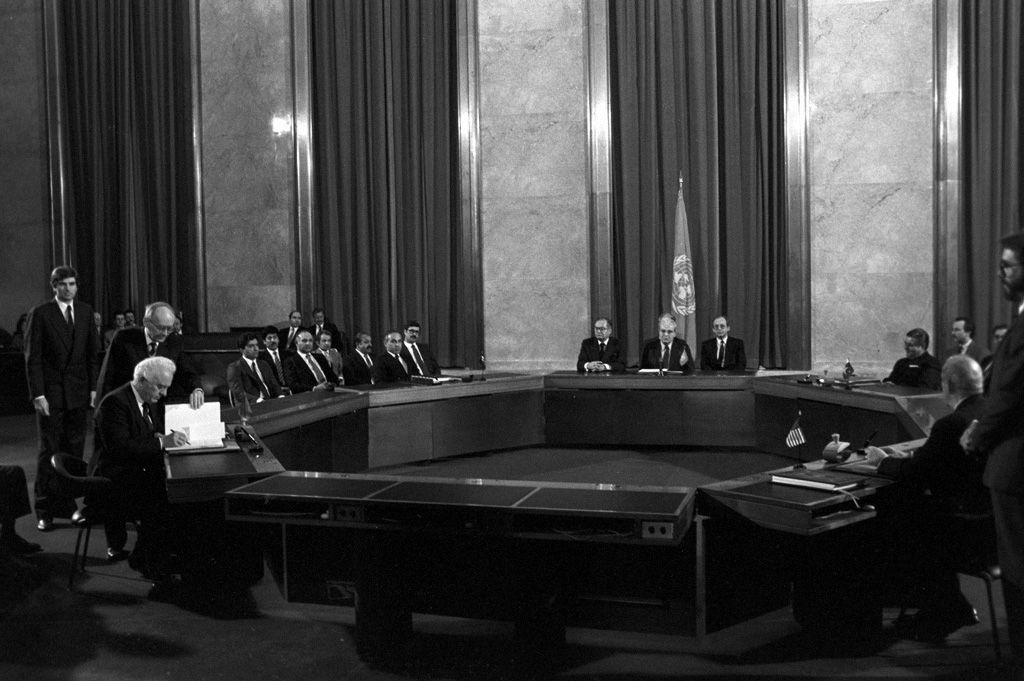
At the Palais des Nations, a large United Nations building in Geneva, Switzerland, officials signed papers that set a path for troops from the Soviet Union to leave Afghanistan. The Soviet Union was a large communist country that no longer exists. This was the signing of the Geneva Accords, agreements about Afghanistan made in Geneva. It was part of the Soviet-Afghan War, a war in which troops from the Soviet Union fought in Afghanistan to support its government against Afghan rebels. It began and ended on April 14, 1988.
The path to the signing began with Mikhail Gorbachev, the leader of the Soviet Union. On February 9, 1988, Gorbachev said troops from his country would start leaving Afghanistan on May 15, 1988, if an agreement was reached in Geneva. Moscow wanted better relations with the United States, because talks about American missiles in Europe depended on them.
Because Gorbachev’s start date depended on an agreement, negotiators in Geneva finished the papers and arranged the signing. On April 14, 1988, Pakistan, the country next to Afghanistan, and Afghanistan’s government signed the agreements. George Shultz, the United States official in charge of dealing with other countries, and Eduard Shevardnadze, the Soviet Union official with the same job, signed one agreement as witnesses.
That agreement gave the timetable for the withdrawal, the pulling back of an army from a place. It said the Soviet Union would begin pulling out its troops on May 15, 1988, and finish within nine months. After the short signing, the promise to leave Afghanistan had dates written into an agreement.
This is one part of Soviet-Afghan War.
When
Sometime on April 14, 1988.
- What the source says
- At a ceremony in the Palais des Nations in Geneva on 14 April 1988
- Written for the computer as
1988-04-14(Gregorian calendar, UTC; years at or below zero are BC: −0005 is 6 BC)- How sure
- exact, to the day
- Worked out by
- the Chronum server, method
edtf_gregorian_utcversion 1: the period lies within the written day
History Snippet never shows a single "best guess" date. The bar is the whole span the evidence allows; the hatched part means "somewhere in here". Why.
How we know
Took place at: The accords were signed at a ceremony in the Palais des Nations in Geneva on April 14, 1988, by Pakistan and the Kabul-based Afghan government.
Claim status: submitted, awaiting review
- supports The Geneva Accords of April 1988 (Chapter 2), The Soviet Withdrawal from Afghanistan, Chapter 2 summary
At a ceremony in the Palais des Nations in Geneva on 14 April 1988, the Government of Pakistan
Nature of ceremony: The signing itself was short and simple, in contrast to the long, complicated negotiations before it.
Claim status: submitted, awaiting review
- supports Short and sweet signing of Geneva accords ends tortuous negotiations, Opening paragraph
The signing of the Afghan peace accord here yesterday was short and simple
Resulted in: Under the agreement the Soviet Union was to begin pulling out its 115,000 troops from Afghanistan on May 15, 1988.
Claim status: submitted, awaiting review
- supports Short and sweet signing of Geneva accords ends tortuous negotiations, Opening paragraphs
Under the agreement, the Soviet Union will begin pulling out its 115,000 troops from Afghanistan on May 15.
Participated in: US Secretary of State George Shultz and Soviet Foreign Minister Eduard Shevardnadze also signed one of the agreements, as witnesses.
Claim status: submitted, awaiting review
- supports Afghanistan: The Accords, Opening paragraph
Secretary of State George Shultz and Soviet Foreign Minister Eduard Shevardnadze also signed one of the three
Contained withdrawal terms: The Soviet troop withdrawal was written only into the Pakistan-Afghanistan agreement, called the fourth instrument, which Shultz and Shevardnadze witnessed.
Claim status: submitted, awaiting review
- supports Afghanistan: The Accords, Paragraph on the fourth instrument
Also called the fourth instrument, this is the agreement witnessed by Secretary Shultz and Minister Shevardnadze
Preceded by: On February 9, 1988, Gorbachev announced that the Soviet Union was ready to start withdrawing its troops on May 15, 1988.
Claim status: submitted, awaiting review
- supports The Other 'Peace Process' on Afghanistan: Geneva Talks 1982-1988, Section: Breaking the deadlock
Gorbachev announced on 9 February 1988 that the Soviet Union was ready to start the withdrawal of its troops
Caused by: Success in Moscow's missile negotiations depended on better relations with the United States, which a successful withdrawal from Afghanistan would help.
Claim status: submitted, awaiting review
- supports The war before the war: Soviet precedent in Afghanistan, Section: Timing
Success in these negotiations depended on improving relations with the United States.
Sources disagree: Sources count the agreements differently: one describes three agreements between Pakistan and Afghanistan with the superpowers as witnesses, while another lists four instruments in all.
Claim status: submitted, awaiting review
Where
Palais des Nations, Geneva
- Coordinates
- 46.2267, 6.1406 (modern map coordinates)
- Error distance
- the true spot could be up to 300 m from those coordinates
- Today this spot lies in
- Switzerland
Borders shown are today's; the record says where the place is on the modern map, not what country ruled it then.
Who and what
- personGeorge Shultz
was there
- personEduard Shevardnadze
was there
- personMikhail Gorbachev
led
Pictures
Record history
Every change is a new version; older versions stay readable forever.
- Version 3 · 2026-11-21 16:31 UTC · submitted, awaiting review
published after review of the private record