
Events › Soviet-Afghan War › Soviet failure to defeat the Afghan guerrillas
Soviet failure to defeat the Afghan guerrillas
Record status: submitted, awaiting review · version 3 · record history
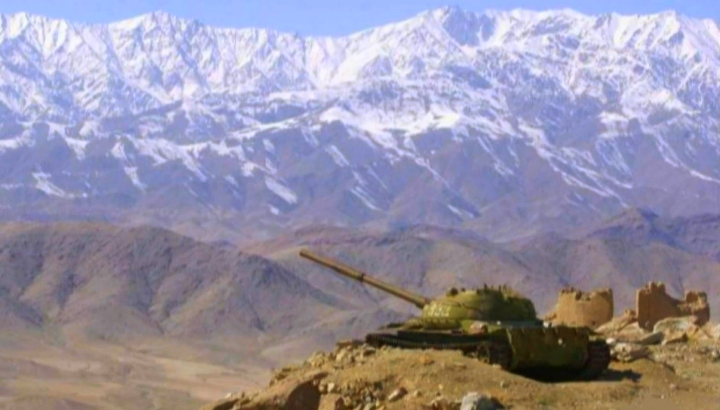
Afghan fighters could not stand against Soviet firepower in open battle, so they moved into the mountains and struck from hiding. This was part of the Soviet-Afghan War, a war in which Soviet troops fought in Afghanistan to support its government against Afghan rebels. It happened mainly in the countryside and mountains outside the main cities. It began in December 1979 and ended in 1989.
The Soviet Union, a huge Communist country led from Moscow, sent its army because it wanted to support the Communist government, a one-party government that ran Afghanistan’s economy. That government was struggling against a wide rebellion in the countryside. Afghan Muslim fighters called mujahideen opposed that government and the Soviet troops backing it. They did not accept Soviet control.
At the end of December 1979, Soviet troops took Kabul, the capital city of Afghanistan, and large parts of the country. Soviet firepower was too strong for the mujahideen in open battle, so the fighters retreated into the mountains and used guerrilla warfare, a way of making surprise attacks and then hiding. Because Soviet leaders never won the loyalty of ordinary Afghans, the attacks kept going.
The mujahideen also had Pakistan, the country next to Afghanistan, as a safe place to rest and get supplies. Because of that, the Soviet army could not stamp out the resistance. Soviet leaders came to see the war as a lost cause. After the 1988 Geneva accords set a timetable for leaving, Soviet troops withdrew and were gone by 1989. The mujahideen kept fighting to overthrow the government.
This is one part of Soviet-Afghan War.
When
Began in December 1979; ended in 1989.
- What the source says
- At the end of December 1979, the Soviet Union sent thousands of troops into Afghanistan; Soviet troops were gone by 1989.
- Written for the computer as
1979-12/1989(Gregorian calendar, UTC; years at or below zero are BC: −0005 is 6 BC)- How sure
- approximate, to the year
- Worked out by
- the Chronum server, method
edtf_gregorian_utcversion 1: a span: started in the first written date, ended in the second
History Snippet never shows a single "best guess" date. The bar is the whole span the evidence allows; the hatched part means "somewhere in here". Why.
How we know
Began on: At the end of December 1979 the Soviet Union sent thousands of troops into Afghanistan and took control of Kabul and large parts of the country. The guerrilla resistance then fought them over the following years.
Claim status: submitted, awaiting review
- supports The Soviet Invasion of Afghanistan and the U.S. Response, 1978-1980, Opening paragraph
the Soviet Union sent thousands of troops into Afghanistan and immediately assumed complete military and political control of Kabul
Resulted in: The Soviet intervention led to the rise of the mujahideen, local resistance fighters who fought by guerrilla warfare.
Claim status: submitted, awaiting review
- supports Soviet War in Afghanistan, Overview
The conflict led to the emergence of the Mujahideen, local resistance fighters who engaged in guerrilla warfare.
Took place at: After Soviet firepower overwhelmed them in open battle, the mujahideen fell back into the mountains and the population and kept up guerrilla attacks.
Claim status: submitted, awaiting review
- supports Afghanistan: The Soviet Union's War in Vietnam, Section: Guerrilla Attacks and Civilian Casualties
mujahideen forces retreated into the mountains or melted into a population made friendly
Caused by: Soviet commanders did not grasp that to defeat an insurgency they first had to win the loyalty of ordinary people.
Claim status: submitted, awaiting review
- supports Afghanistan: The Soviet Union's War in Vietnam, Concluding section
Soviet commanders never grasped the concept that, in order to defeat an insurgency
Caused by: The war could not be won while Pakistan remained a safe haven for the mujahideen.
Claim status: submitted, awaiting review
- supports Afghanistan: The Soviet Union's War in Vietnam, Concluding section
The war could never have been won so long as Pakistan remained a mujahideen safe haven.
Resulted in: The Soviets came to see the Mujahideen as uncontrollable and the war as a lost cause, but they did not start pulling out until the 1988 Geneva accords set a timetable.
Claim status: submitted, awaiting review
- supports Soviet War in Afghanistan, Full article, closing paragraphs
the Mujahideen could not be controlled and that the war was a lost cause
Ended on: Even after Soviet troops were gone in 1989, the mujahideen stayed determined to overthrow the Communist government.
Claim status: submitted, awaiting review
- supports Soviet War in Afghanistan, Full article, closing paragraphs
the Mujahideen, further inflamed by the years of war, remained determined to overthrow the Communist regime.
Sources disagree: The sources give no single date, building or town for this outcome, which was a long process across Afghanistan, and they do not agree on exactly when the Soviets accepted that the war could not be won.
Claim status: submitted, awaiting review
Where
Afghanistan, mainly the countryside and mountains outside the main cities
- Coordinates
- 33.9000, 67.7000 (modern map coordinates)
- Error distance
- the true spot could be up to 600,000 m from those coordinates (600.0 km)
- Today this spot lies in
- Afghanistan
Borders shown are today's; the record says where the place is on the modern map, not what country ruled it then.
Who and what
No people, places or objects are linked yet.
Pictures
Record history
Every change is a new version; older versions stay readable forever.
- Version 3 · 2026-11-21 14:31 UTC · submitted, awaiting review
published after review of the private record