
Events › Soviet-Afghan War › Storming of the Tajbeg Palace in Kabul
Storming of the Tajbeg Palace in Kabul
Record status: submitted, awaiting review · version 3 · record history
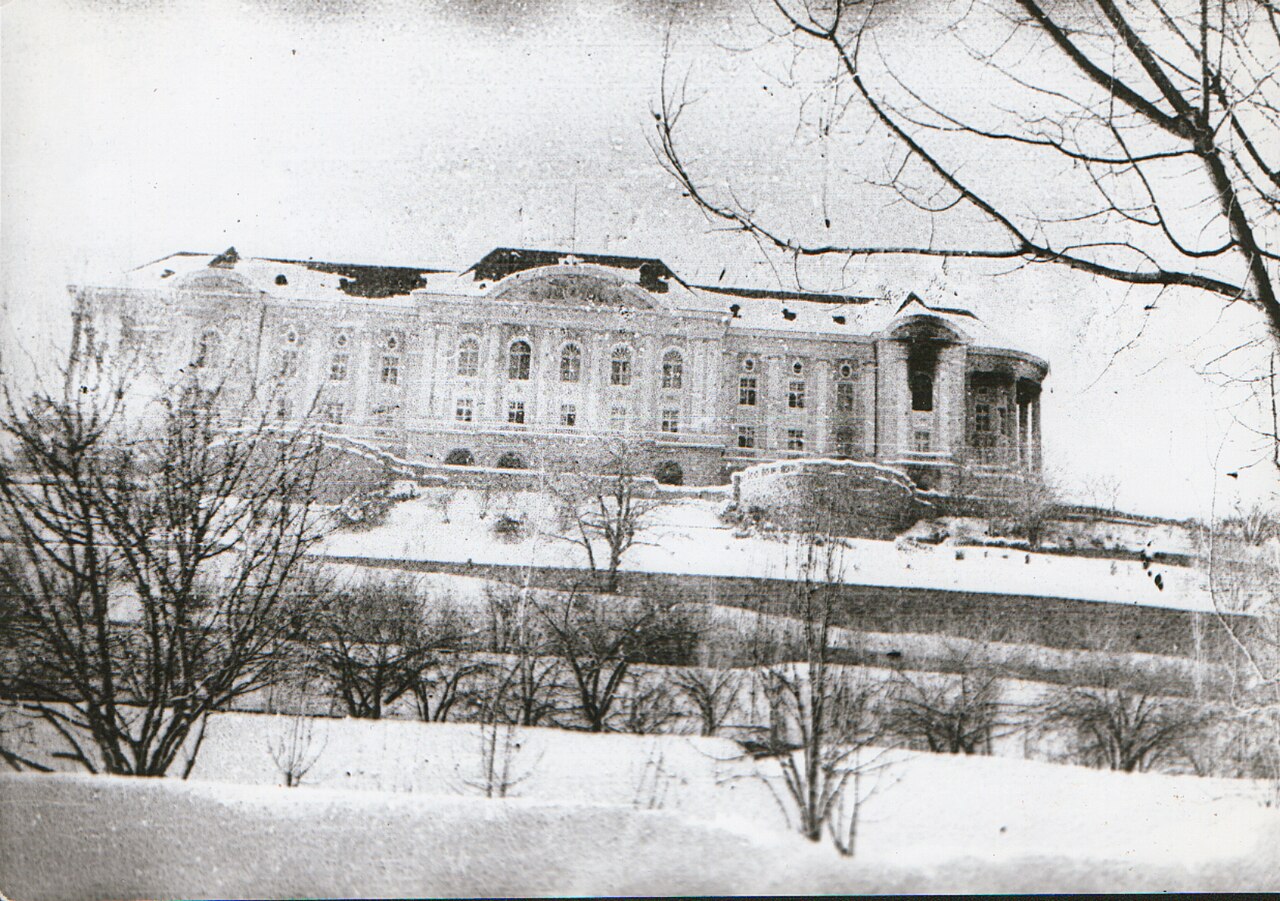
On December 27, 1979, a spy agent from the Soviet Union, a huge country led from Moscow, worked as a cook and poisoned Afghan president Hafizullah Amin and his ministers at lunch. This story is about the storming of the Tajbeg Palace, a large hilltop palace in Kabul, the capital city of Afghanistan. It was part of the Soviet-Afghan War, a war in which troops from the Soviet Union fought Afghan rebels to defend Afghanistan’s government. It began and ended on December 27, 1979.
Leaders in Moscow feared that Amin wanted Afghanistan to depend less on the Soviet Union. They were also angry that Amin had Nur Muhammad Taraki, the Afghan leader before him, killed. In October 1979, they decided to remove Amin and make Babrak Karmal, an Afghan leader they trusted more, president.
The poison did not finish the job. Two doctors from the Soviet Union, who did not know about the plot, worked to save Amin. After about four hours, Amin woke up. Because Amin had recovered, and Moscow still wanted him removed, specially trained soldiers from the Soviet Union stormed the palace that evening. Fierce fighting followed while Amin lay in bed.
Amin was killed in the fighting because the Afghan forces defending him had little chance against the attackers. That night, a radio station said Karmal had overthrown Amin. Moscow put Karmal in charge because its leaders wanted someone who would keep Afghanistan’s government in place and stay loyal to Moscow. Amin’s death removed the leader they distrusted and put Karmal in his place.
This is one part of Soviet-Afghan War.
When
Sometime on December 27, 1979.
- What the source says
- It was December 27, 1979.
- Written for the computer as
1979-12-27(Gregorian calendar, UTC; years at or below zero are BC: −0005 is 6 BC)- How sure
- exact, to the day
- Worked out by
- the Chronum server, method
edtf_gregorian_utcversion 1: the period lies within the written day
History Snippet never shows a single "best guess" date. The bar is the whole span the evidence allows; the hatched part means "somewhere in here". Why.
How we know
Resulted in: Over 200 Afghans were killed and over 1,000 surrendered in the fighting at the palace.
Claim status: submitted, awaiting review
- supports Poisonings, Assassination, And A Coup: The Secret Soviet Invasion Of Afghanistan, Operation Storm-333 section
Over 200 Afghans were killed and over 1,000 surrendered.
Preceded by: On the same day, Amin was poisoned at lunch by a KGB agent working as a cook. Soviet doctors, who knew nothing of the plot, revived him over about four hours.
Claim status: submitted, awaiting review
- supports Poisonings, Assassination, And A Coup: The Secret Soviet Invasion Of Afghanistan, Opening scene, Operation Storm-333 section
After four long hours, Amin gradually regained consciousness.
Caused by: The Soviets believed Karmal, an ally, would control Afghanistan and keep it loyal to Moscow.
Claim status: submitted, awaiting review
- supports Soviet Union Installs a Puppet Government in Afghanistan, The Soviet Union Installs a Puppet Government in Afghanistan
The Soviets believed that Karmal, an ally, would be able to effectively control the country
Resulted in: Soviet troops killed Amin and installed Babrak Karmal as head of government.
Claim status: submitted, awaiting review
- supports The Soviet Invasion of Afghanistan — December 1979, Opening summary
Forces loyal to Amin then executed Taraki in October—a move that infuriated Moscow.
Sources disagree: Sources differ on how many Soviet personnel died and on whether Karmal took office that night or the next day.
Claim status: submitted, awaiting review
Where
Tajbeg Palace, Kabul, Afghanistan
- Coordinates
- 34.4885, 69.1105 (modern map coordinates)
- Error distance
- the true spot could be up to 1,500 m from those coordinates (1.5 km)
- Today this spot lies in
- Afghanistan
Borders shown are today's; the record says where the place is on the modern map, not what country ruled it then.
Who and what
- personHafizullah Amin
was killed in
- personBabrak Karmal
was there
- personViktor Karpukhin
led
Pictures
Record history
Every change is a new version; older versions stay readable forever.
- Version 3 · 2026-11-21 12:31 UTC · submitted, awaiting review
published after review of the private record