
Events › English Civil War › Charles I Dissolves Parliament in 1629
Charles I Dissolves Parliament in 1629
Record status: submitted, awaiting review · version 2 · record history
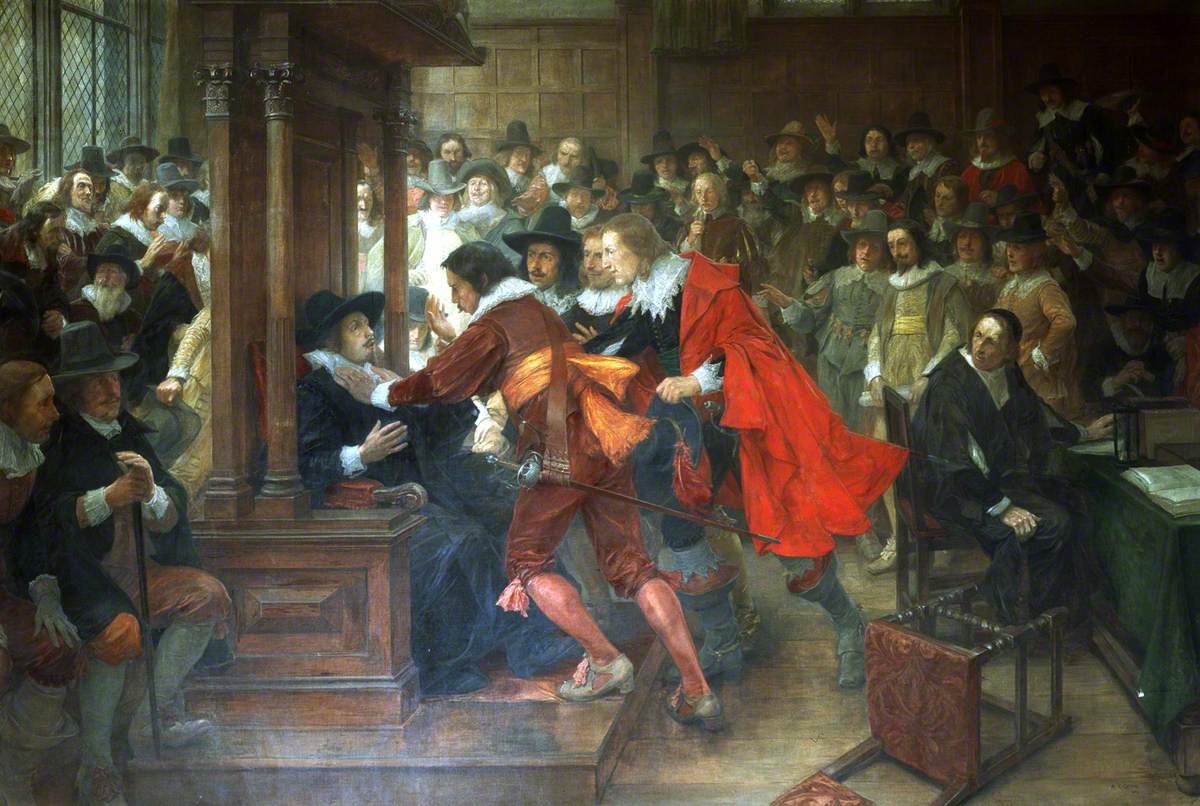
On March 2, 1629, Denzil Holles, a lawmaker, and Benjamin Valentine, another lawmaker, held Sir John Finch, the man who led the meeting, in his chair. This clash came before a bigger struggle, the English Civil War, a series of wars from 1642 to 1651 over who should rule England. This event was King Charles I ending Parliament, the group of lawmakers that advised the king and agreed to taxes, at the House of Lords, the part made up of nobles and bishops, in Westminster, the part of London where lawmakers met. It began and ended on March 10, 1629.
Charles and many lawmakers had argued for years. They wanted him to stop collecting ship taxes without their agreement. They also feared church practices that seemed too close to Catholic worship. Charles saw what happened to Finch as a public attack on his royal authority, so he chose to end Parliament.
Because Charles had ordered Finch to stop the meeting for a while, Holles and Valentine held Finch in place. They wanted three written statements by Sir John Eliot, a leading lawmaker, read before the meeting could end. The statements condemned taxes taken without the lawmakers’ consent and the church changes. After this, Charles denounced the lawmakers because he felt they had publicly condemned his royal authority.
On March 10, 1629, Charles went to the House of Lords and ended Parliament himself because he did not want to risk another meeting. He then had nine leading lawmakers arrested, including Eliot, Holles, and Valentine, because he treated them as ringleaders. Afterward, Charles ruled England without calling Parliament until 1640, because he had become deeply disenchanted with such meetings.
This is one part of English Civil War.
When
Sometime on March 10, 1629.
- What the source says
- The king appeared before parliament one week later on 10 March to dissolve parliament in person.
- Written for the computer as
1629-03-10(Gregorian calendar, UTC; years at or below zero are BC: −0005 is 6 BC)- How sure
- exact, to the day
- Worked out by
- the Chronum server, method
edtf_gregorian_utcversion 1: the period lies within the written day
History Snippet never shows a single "best guess" date. The bar is the whole span the evidence allows; the hatched part means "somewhere in here". Why.
How we know
Began on: Charles I formally dissolved Parliament on March 10, 1629, and an 11-year period of governing without one began.
Claim status: submitted, awaiting review
- supports Charles I dissolves parliament and begins 11 years of 'Personal Rule', Opening paragraph
On 10 March 1629, King Charles I formally dissolved parliament, beginning an 11-year period of governing without it
Took place at: Charles went to the House of Lords at Westminster and declared the Parliament dissolved in person.
Claim status: submitted, awaiting review
- supports Ruling without Parliament - Charles I, Transcript, early section
Charles I went down to the House of Lords, pronounced that the parliament was dissolved and the Personal Rule began.
Caused by: When the Commons met again, Charles ordered the Speaker, Sir John Finch, to adjourn the House once more.
Claim status: submitted, awaiting review
- supports 1625-29: Charles I - the first crisis, Section on the 1629 session
Charles ordered the Speaker, Sir John Finch, to adjourn once more.
Caused by: Two members held the Speaker in his chair so the adjournment could not happen while Eliot's three resolutions were read out.
Claim status: submitted, awaiting review
- supports 1625-29: Charles I - the first crisis, Section on the 1629 session
Denzil Holles and Benjamin Valentine held the Speaker in his chair, while Eliot's three resolutions were read out.
Caused by: Charles had been in near-constant conflict with MPs since 1625 over his right to collect customs duties called tonnage and poundage.
Claim status: submitted, awaiting review
- supports Charles I dissolves parliament and begins 11 years of 'Personal Rule', Background paragraphs
Charles had been in near-constant conflict with MPs over his right to collect customs duties
Sources disagree: Sources differ on the day the Speaker was held in his chair (March 2 or March 10, 1629), and on whether the dissolution was proclaimed on March 2 or made by the king in person on March 10. The in-person dissolution on March 10 is the date they agree on.
Claim status: submitted, awaiting review
Where
House of Lords, Palace of Westminster, London
- Coordinates
- 51.4999, -0.1248 (modern map coordinates)
- Error distance
- the true spot could be up to 300 m from those coordinates
- Today this spot lies in
- United Kingdom
Borders shown are today's; the record says where the place is on the modern map, not what country ruled it then.
Who and what
- personCharles I of England
led
- personSir John Eliot
led
- personDenzil Holles
was there
- personBenjamin Valentine
was there
- personSir John Finch
was there
Pictures
Record history
Every change is a new version; older versions stay readable forever.
- Version 2 · 2026-11-21 19:33 UTC · submitted, awaiting review
published after review of the private record