
Events › English Civil War
English Civil War
Record status: submitted, awaiting review · version 2 · record history
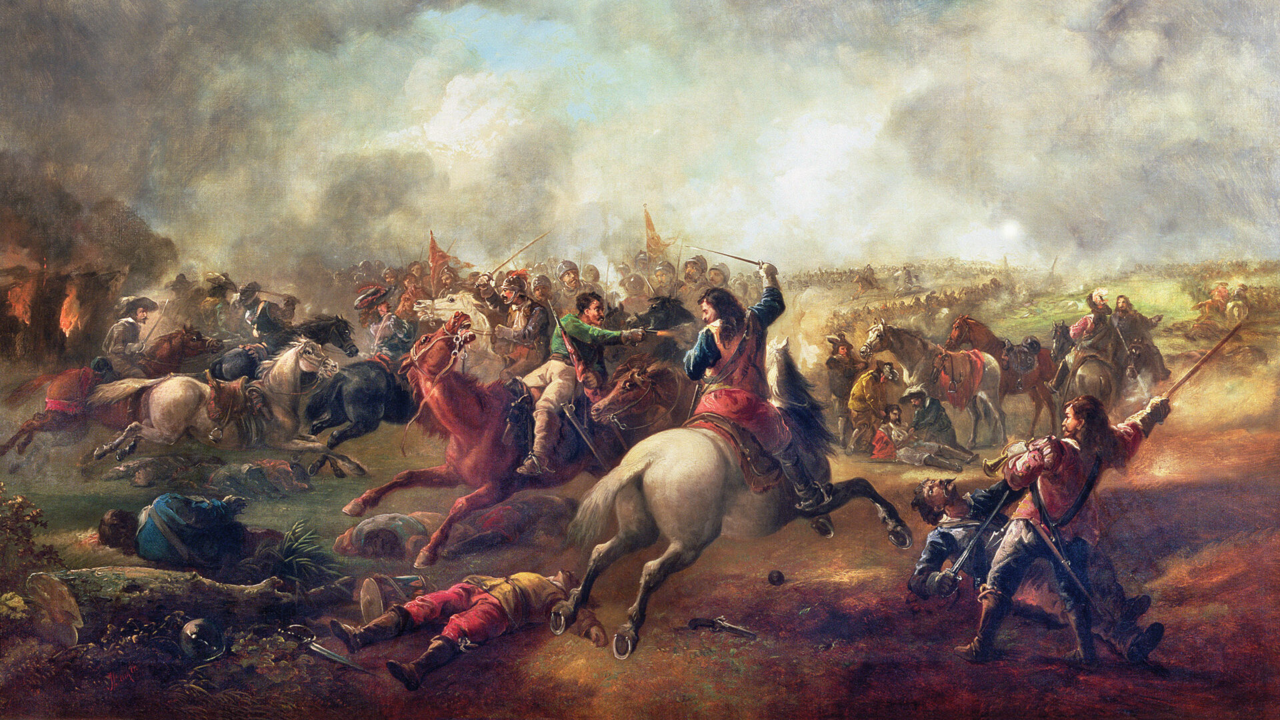
On January 4, 1642, Charles I, the king of England who fought lawmakers over power, ordered the arrest of five members of Parliament, the group that made laws and agreed to taxes in England. That order pushed a long quarrel toward war. The English Civil War was a fight in England over who held power. It began in 1642 and ended on September 3, 1651.
Charles and Parliament had argued over power in the kingdom, taxes, money, and religion. In 1629, Charles dissolved Parliament, which means he ended it and sent its members home, because its members kept opposing him over money and religion. He ruled without Parliament until 1640. Then he called it back because he needed money for wars against Scotland, the country north of England ruled by the same kings.
In April 1640, Charles called Parliament back, but he dismissed it within weeks because he would not give in to its demands. In November 1640, he called a new Parliament. The two sides did not trust each other. Many members of Parliament feared the king might use an army to force his will on them. After Charles ordered the arrests, the quarrel between the king and Parliament turned into open war.
The first real fighting took place at Powick Bridge, a bridge near Worcester, an English city, on September 23, 1642. Then the armies fought at Edgehill, a hill in central England where the first big battle was fought, on October 23, 1642. Neither side won there, so the war went on. Parliament built the New Model Army, a full-time army made to win the war, and it defeated the king’s army at Naseby, a village in central England, on June 14, 1645.
That defeat broke the king’s side, so its headquarters at Oxford surrendered in June 1646. Charles was put to death as a punishment on January 30, 1649, and his son Charles II kept fighting. Oliver Cromwell, Parliament’s greatest army leader, defeated Charles II at Worcester on September 3, 1651, because Charles II had marched his army into England. Charles II fled to another country. Afterward, Parliament’s side had won, England had no king for a time, and the British Isles had their first permanent national army.
Inside this event
When
Began in 1642; ended on September 3, 1651.
- What the source says
- Fought between 1642 and 1651, these wars were primarily disputes between Crown and Parliament about how the British Isles should be governed.
- Written for the computer as
1642/1651-09-03(Gregorian calendar, UTC; years at or below zero are BC: −0005 is 6 BC)- How sure
- approximate, to the year
- Worked out by
- the Chronum server, method
edtf_gregorian_utcversion 1: a span: started in the first written date, ended in the second
History Snippet never shows a single "best guess" date. The bar is the whole span the evidence allows; the hatched part means "somewhere in here". Why.
How we know
Caused by: Money disputes and religious disagreement between Charles I and Parliament brought the two sides to civil war in 1642.
Claim status: submitted, awaiting review
- supports The English Civil War (1642-1651), Charles II section
Fiscal and religious discord brought Charles I and Parliament to civil war in 1642.
Precipitated by: The event that finally led to war was Charles I's order on January 4, 1642 to arrest five members of Parliament.
Claim status: submitted, awaiting review
- supports English Civil Wars, Outbreak of war
was the order by Charles I, on January 4, 1642, to arrest five members of Parliament.
Caused by: Charles I dissolved Parliament in 1629 and began the Personal Rule (1629-1640), trying to govern without a Parliament.
Claim status: submitted, awaiting review
- supports English Civil Wars, Background
Charles dissolved Parliament and inaugurated the period of Personal Rule (1629-1640)
Turning point: The Battle of Naseby, fought on June 14, 1645, was the decisive battle of the war after nearly three years of conflict.
Claim status: submitted, awaiting review
- supports The Battle of Naseby, Battle of Naseby
After nearly three years of conflict, this was the decisive battle of the Civil War.
Ended on: Charles II invaded England with an army, and it was defeated at Worcester on September 3, 1651. Charles was forced back into exile.
Claim status: submitted, awaiting review
- supports British Civil Wars, Third Civil War and Protectorate, 1650-58
This was defeated at Worcester on 3 September 1651 and Charles was forced back into exile.
Ended on: The Battle of Worcester on September 3, 1651 was the final defeat of the Royalist forces in England.
Claim status: submitted, awaiting review
- supports The English Civil War (1642-1651), Worcester, September 3, 1651
The Battle of Worcester was the final defeat for the Royalist forces in England
Sources disagree: Sources agree the fighting in England ended at Worcester on September 3, 1651. They do not give one start date, and some include the earlier Scottish conflict from 1639 as part of the wider wars.
Claim status: submitted, awaiting review
Where
England
- Coordinates
- 52.5000, -1.5000 (modern map coordinates)
- Error distance
- the true spot could be up to 400,000 m from those coordinates (400.0 km)
- Today this spot lies in
- United Kingdom
Borders shown are today's; the record says where the place is on the modern map, not what country ruled it then.
Who and what
Pictures
Record history
Every change is a new version; older versions stay readable forever.
- Version 2 · 2026-11-21 18:32 UTC · submitted, awaiting review
published after review of the private record