
Events › Korean War › Chinese attack on the Eighth Army at the Ch'ongch'on River
Chinese attack on the Eighth Army at the Ch'ongch'on River
Record status: submitted, awaiting review · version 3 · record history
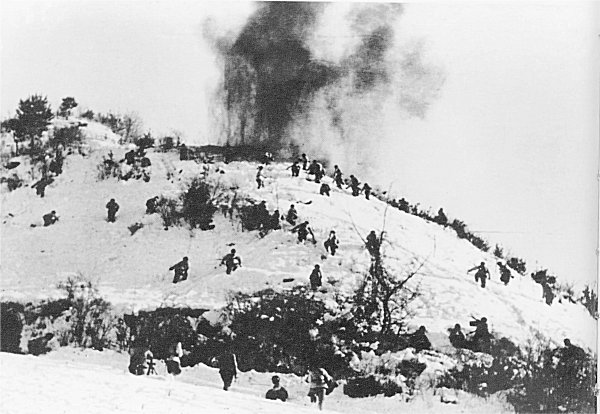
About 180,000 Chinese soldiers were ready to attack soldiers who expected little resistance. This was part of the Korean War, a war from 1950 to 1953 in which North Korea, helped by China, fought South Korea, helped by United Nations forces, soldiers from South Korea, the United States and other countries. It happened on November 25, 1950, at the Ch'ongch'on River, a river in northwestern North Korea.
United Nations forces had pushed north to within about 40 miles of the Chinese border. China wanted to stop that advance, so Chinese Communist Forces, armies sent by Communist China to fight in Korea, moved in large numbers into North Korea. The Chinese chose the night of November 25, 1950, to strike the Eighth Army, the main United States Army force in Korea, which also had soldiers from other countries.
On November 24, 1950, the Eighth Army began moving north toward the Chinese border. By the next evening, the Chinese began the Second Phase Offensive, the big Chinese attack that pushed United Nations forces back. They struck along the whole Eighth Army front at the river. Because the main Chinese attack in the Eighth Army’s area aimed at the South Korean II Corps, a large group of South Korean soldiers made up of several divisions, the Chinese broke through that part of the line.
On November 28, 1950, Douglas MacArthur, the American general commanding all United Nations forces in Korea, told Washington, the United States government leaders, that the United Nations faced an entirely new war. On November 29, 1950, he told the Eighth Army’s commander to pull back, because the Chinese could surround the army if it stayed. The Eighth Army retreated from the Ch'ongch'on River line, and the United Nations advance toward China ended.
This is one part of Korean War.
When
Sometime on November 25, 1950.
- What the source says
- On the evening of November 25, 1950, the Chinese Communist Forces launched a massive attack on the entire front of the United States Eighth Army
- Written for the computer as
1950-11-25(Gregorian calendar, UTC; years at or below zero are BC: −0005 is 6 BC)- How sure
- exact, to the day
- Worked out by
- the Chronum server, method
edtf_gregorian_utcversion 1: the period lies within the written day
History Snippet never shows a single "best guess" date. The bar is the whole span the evidence allows; the hatched part means "somewhere in here". Why.
How we know
Began on: On November 25, 1950, Chinese forces attacked the center and right of the United States Eighth Army.
Claim status: submitted, awaiting review
- supports The Korean War: Phase 3: 3 November 1950-24 January 1951 (CCF Intervention), Phase 3 timeline, entry for 25 Nov
Chinese forces attack Eighth Army center and right.
Took place at: The attack came on the evening of November 25, 1950. It hit the whole front of the Eighth Army, which was holding the line at the Ch'ongch'on River in North Korea.
Claim status: submitted, awaiting review
- supports Cpl. Ray Dean Hulsey - Service Member Profile, Opening paragraph of the profile
the Chinese Communist Forces launched a massive attack on the entire front of the United States Eighth Army
Force size: By the evening of November 25, about 180,000 Chinese soldiers were getting ready to attack the Eighth Army.
Claim status: submitted, awaiting review
- supports MacArthur Provokes China's First Phase Offensive in Korea, China Strikes Back section
By the evening of November 25, 180,000 Chinese were preparing to attack the Eighth Army.
Caused by: UN forces had advanced to within about 40 miles of the Chinese border by late November. China then intervened on a massive scale, halting the UN advance.
Claim status: submitted, awaiting review
- supports Korean War, Escalation, November 1950: China declares war
intervened on a massive scale, halting the UN advance
Surprise: Eighth Army leaders thought their offensive was going to plan on the evening of November 25, just before the Chinese attacked.
Claim status: submitted, awaiting review
- supports MacArthur Provokes China's First Phase Offensive in Korea, China Strikes Back section
it appeared that the offensive was going according to plan
Resulted in: After the Chinese broke through, American commanders ordered Eighth Army units to fall back in succession.
Claim status: submitted, awaiting review
- supports Cpl. Ray Dean Hulsey - Service Member Profile, Second paragraph of the profile
American commanders ordered units of the Eighth Army to fall back in succession
Resulted in: On November 29, 1950, MacArthur told General Walker to withdraw as needed to avoid being surrounded. The Eighth Army then began a general withdrawal from the Ch'ongch'on River line.
Claim status: submitted, awaiting review
- supports The Korean War: Phase 3: 3 November 1950-24 January 1951 (CCF Intervention), Phase 3 narrative, paragraph on November 28-29
he instructed General Walker to withdraw as necessary to escape being enveloped by the Chinese
Where
Ch'ongch'on River, North Korea
- Coordinates
- 39.7100, 125.8400 (modern map coordinates)
- Error distance
- the true spot could be up to 60,000 m from those coordinates (60.0 km)
- Today this spot lies in
- North Korea
Borders shown are today's; the record says where the place is on the modern map, not what country ruled it then.
Who and what
Pictures
Record history
Every change is a new version; older versions stay readable forever.
- Version 3 · 2026-11-14 08:10 UTC · submitted, awaiting review
published after review of the private record