
Events › Korean War
Korean War
Record status: submitted, awaiting review · version 2 · record history
North Korean forces crossed the 38th parallel, an imaginary line across Korea that divided the North from the South, and invaded South Korea. The Korean War was a war on the Korean Peninsula, a piece of land in East Asia that is now split into North Korea and South Korea. The Korean War began on June 25, 1950, and ended on July 27, 1953.
The war grew out of a split after World War II. The Soviet Union, a large Communist country led from Moscow, backed the government in the North. Communist means supporting a system in which the government controls the economy and only one party rules. The United States backed the government in the South. North Korea wanted to conquer South Korea and unite Korea under its Communist government.
Because North Korea wanted that control, its forces invaded on June 25, 1950. South Korea could not stop the attack, so North Korean forces captured Seoul, the capital city of South Korea, on June 28, 1950. The same day the attack began, a council in the United Nations, a group of countries that work together to keep peace, called for both sides to stop shooting for a time. North Korea ignored that call.
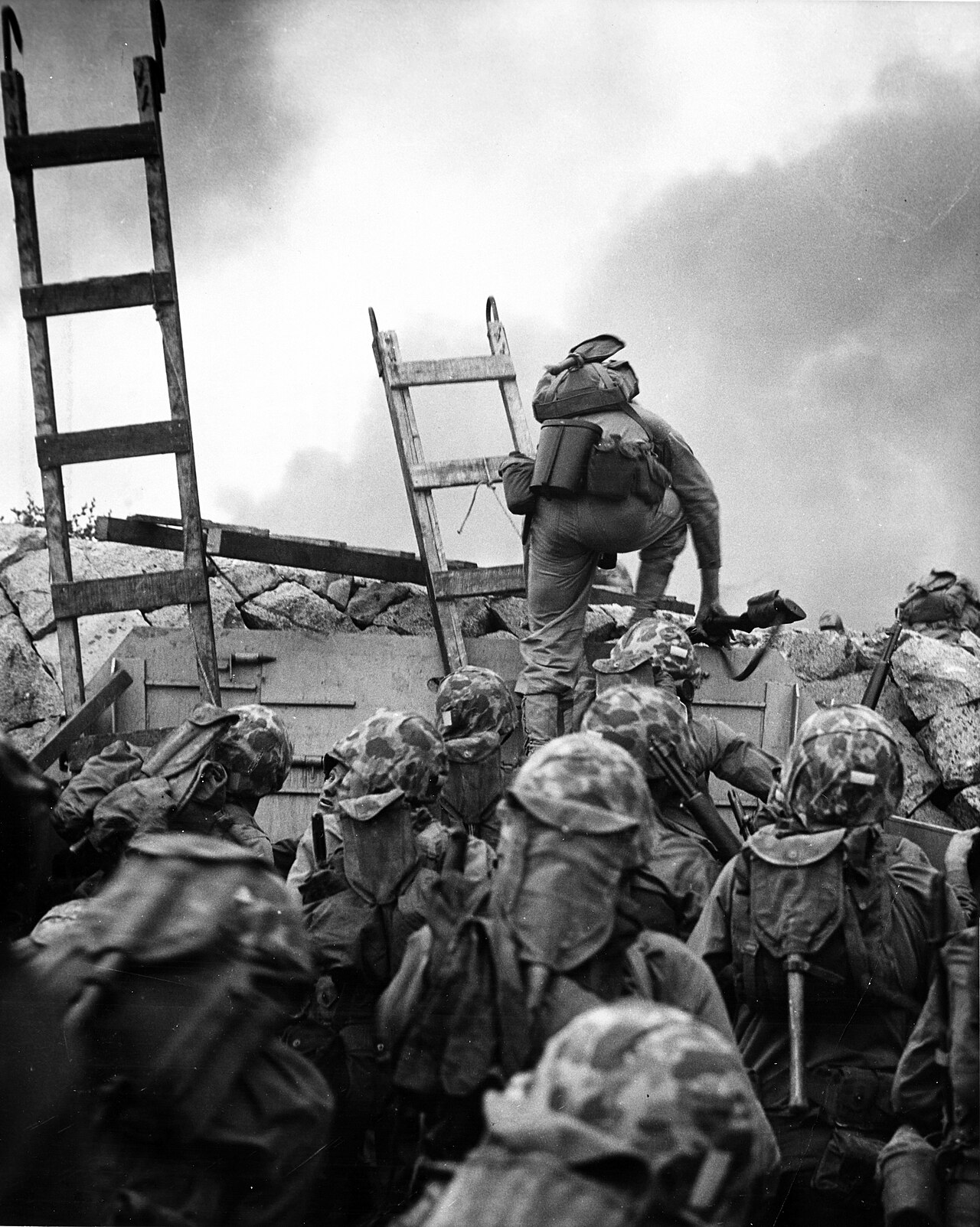
Because the attack went on, that council asked its members to help South Korea on June 27, 1950. The United States president sent American ground troops on June 30, 1950. In September 1950, an American general landed troops at a port city near Seoul because the forces helping South Korea wanted to cut off the North Korean army and drive it out. They pushed North Korean forces back behind the 38th parallel. In late November 1950, Chinese forces attacked in full strength and pushed United Nations forces south of the 38th parallel.
The fighting stopped after long talks. Both sides agreed to talks in 1951, but they argued for two more years over what to do with captured enemy soldiers. On July 27, 1953, an armistice, an agreement to stop fighting that is not a peace treaty, was signed at a village on the border. North and South Korea stayed separate, holding almost the same land as before, and the border stayed one of the most dangerous places on earth.
Inside this event
- June 25, 1950North Korean invasion of South Korea
- June 27, 1950United Nations Security Council vote to help South Korea
- June 28, 1950Capture of Seoul by North Korean forces
- September 15, 1950Inchon Landing
- November 25, 1950Chinese attack on the Eighth Army at the Ch'ongch'on River
- July 27, 1953Signing of the Korean Armistice Agreement at Panmunjom
When
Began on June 25, 1950; ended on July 27, 1953.
- What the source says
- The Korean War ... was fought from June 25, 1950, to July 27, 1953.
- Written for the computer as
1950-06-25/1953-07-27(Gregorian calendar, UTC; years at or below zero are BC: −0005 is 6 BC)- How sure
- exact, to the day
- Worked out by
- the Chronum server, method
edtf_gregorian_utcversion 1: a span: started in the first written date, ended in the second
History Snippet never shows a single "best guess" date. The bar is the whole span the evidence allows; the hatched part means "somewhere in here". Why.
How we know
Began on: The war began on June 25, 1950, when North Korean forces crossed the 38th parallel and invaded South Korea.
Claim status: submitted, awaiting review
- supports Korean War Armistice Agreement, 1953, Opening paragraphs
when the North Korean forces crossed the thirty-eighth parallel and invaded South Korea
Ended on: The war was fought from June 25, 1950, to July 27, 1953, the day the armistice was signed.
Claim status: submitted, awaiting review
- supports The Korean War, Introduction
was fought from June 25, 1950, to July 27, 1953.
Took place at: North Korean forces attacked in columns across the 38th parallel and invaded the Republic of Korea (South Korea) on the Korean peninsula.
Claim status: submitted, awaiting review
- supports Korean War Overview, Outbreak of the War
attacked in three columns across the 38th parallel and invaded the Republic of Korea (ROK)
Caused by: Korea had been divided into a Communist North backed by the Soviet Union and a pro-Western South backed by the United States, amid post-World War II tensions.
Claim status: submitted, awaiting review
- supports Korean War Begins, Opening paragraphs
Korea had been divided into two separate governments
Resulted in: The United States entered the war: President Truman ordered American ground troops into Korea on June 30, 1950, after the United Nations Security Council asked members to help South Korea.
Claim status: submitted, awaiting review
- supports Korean War Begins, Korean War Begins
on June 30 he ordered American ground troops into the combat zone
Resulted in: In September 1950 General MacArthur's landing at Inchon forced the North Koreans to retreat behind the 38th parallel.
Claim status: submitted, awaiting review
- supports Korean War, Opening paragraph
General MacArthur surprised the North Koreans in September 1950 with an amphibious landing at Inchon behind North Korean lines
Resulted in: The armistice halted the fighting but was not a permanent peace treaty.
Claim status: submitted, awaiting review
- supports Korean War Armistice Agreement, 1953, Opening paragraphs
The armistice, while it stopped hostilities, was not a permanent peace treaty between nations.
Sources disagree: Sources agree the fighting stopped on July 27, 1953, but the armistice was not a peace treaty, so some describe the war as having ended only unofficially or formally.
Claim status: submitted, awaiting review
Where
Korean Peninsula
- Coordinates
- 38.0000, 127.5000 (modern map coordinates)
- Error distance
- the true spot could be up to 500,000 m from those coordinates (500.0 km)
- Today this spot lies in
- South Korea
Borders shown are today's; the record says where the place is on the modern map, not what country ruled it then.
Who and what
- personHarry S. Truman
ruled during
- personDouglas MacArthur
led
Pictures
Record history
Every change is a new version; older versions stay readable forever.
- Version 2 · 2026-11-14 05:02 UTC · submitted, awaiting review
published after review of the private record