
Events › Korean War › Signing of the Korean Armistice Agreement at Panmunjom
Signing of the Korean Armistice Agreement at Panmunjom
Record status: submitted, awaiting review · version 3 · record history
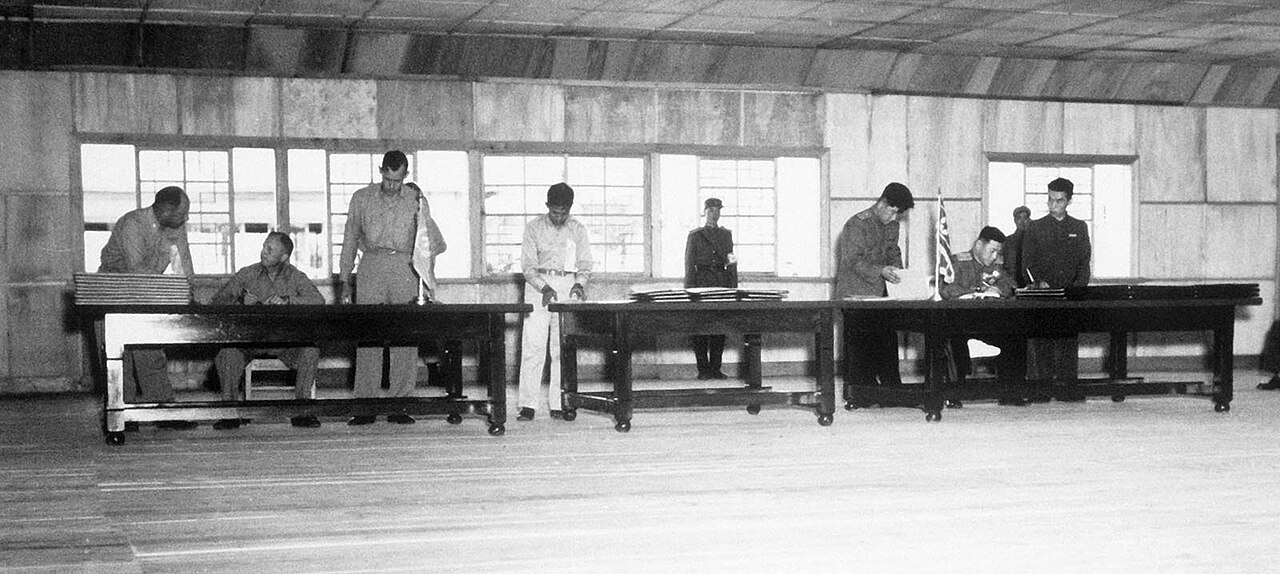
People chosen to speak and act for each side walked into a specially built room at Panmunjom, a small village near the line between North and South Korea, to sign papers that could stop the shooting. This signing was part of the Korean War, a war that began on June 25, 1950, between North Korea, helped by China, and South Korea, helped by forces led by the United States. The signing took place on July 27, 1953.
Both sides wanted the fighting in Korea to stop. Their chosen speakers had met for two years to agree on the terms. The talks dragged on mainly because the two sides disagreed about prisoners of war, soldiers captured by the enemy. Once both sides agreed to release and send them home, the terms were ready to sign.
After 158 meetings over two years and 17 days, the two sides had an armistice, an agreement to stop fighting that is not the same as a final peace. Because the terms were agreed, the two chief signers met at Panmunjom. William K. Harrison Jr., a United States Army general, signed for the United Nations Command, the military force led by the United States that fought for South Korea. Nam Il, a North Korean general, signed for North Korea’s army and the Chinese troops who fought on North Korea’s side. They signed eighteen copies and finished at 10:12 a.m. on July 27, 1953, without exchanging words.
The papers did not stop the fighting at once. Because the agreement had been signed that morning, its terms began about twelve hours later. At 10 p.m. on July 27, 1953, the shooting stopped. Afterward, Korea had a demilitarized zone, a strip of land where neither side was allowed to keep soldiers or weapons.
This is one part of Korean War.
When
Sometime on July 27, 1953.
- What the source says
- At 10:12 a.m. Korean time on July 27, Generals Harrison and Nam Il finished signing the armistice documents
- Written for the computer as
1953-07-27(Gregorian calendar, UTC; years at or below zero are BC: −0005 is 6 BC)- How sure
- exact, to the day
- Worked out by
- the Chronum server, method
edtf_gregorian_utcversion 1: the period lies within the written day
History Snippet never shows a single "best guess" date. The bar is the whole span the evidence allows; the hatched part means "somewhere in here". Why.
How we know
Signed on: Generals Harrison and Nam Il finished signing the armistice documents at 10:12 a.m. Korean time on July 27, 1953.
Claim status: submitted, awaiting review
- supports Foreign Relations of the United States, 1952–1954, Korea, Volume XV, Part 2, Editorial Note, Editorial Note, first sentence
At 10:12 a.m. Korean time on July 27, Generals Harrison and Nam Il finished signing the armistice documents
Took place at: The signing took place in a building put up specially for the ceremony at Panmunjom.
Claim status: submitted, awaiting review
- supports Foreign Relations of the United States, 1952–1954, Korea, Volume XV, Part 2, Editorial Note, Editorial Note, first sentence
at a building especially constructed at Panmunjom for the ceremony.
Participated in: Lt. Gen. Harrison signed for the United Nations Command and Gen. Nam Il for the Korean People's Army and Chinese People's Volunteers; they signed 18 copies in three languages and barely acknowledged each other.
Claim status: submitted, awaiting review
- supports The Korean War, July 27, 1953, Caption text under the heading 'Signing the Korean Armistice'
signed 18 official copies of the tri-language Korean Armistice Agreement in Panmunjom while scarcely acknowledging one other
Duration: Representatives of the two sides entered a specially built room, and Nam Il took ten minutes to sign the eighteen copies.
Claim status: submitted, awaiting review
- supports Korean War Armistice Agreement, 1953, Main text, paragraph on July 27, 1953
took ten minutes to sign eighteen official copies of the tri-language Korean Armistice Agreement
Caused by: Disagreement over what to do with prisoners of war had prolonged the armistice negotiations for two years before the signing.
Claim status: submitted, awaiting review
- supports Korean War Armistice Agreement, 1953, Main text, opening paragraphs
disagreement over repatriation of prisoners of war prolonged the negotiations over the next two years
Resulted in: Fighting went on for twelve hours after the Panmunjom signature; at 10 p.m. on July 27, 1953, the fighting stopped and the armistice began.
Claim status: submitted, awaiting review
- supports Foreign Relations of the United States, 1952–1954, Korea, Volume XV, Part 2, Editorial Note, Editorial Note, third paragraph
Then, at 10 p.m. the fighting stopped and the armistice began.
Sources disagree: One source's photo caption gives July 23, 1953 for the signing photograph, but its text and all the other sources give July 27, 1953, and the sources differ on whether Clark's separate signing at Munsan-ni counts as part of the signing.
Claim status: submitted, awaiting review
Where
Panmunjom, Korea
- Coordinates
- 37.9581, 126.6667 (modern map coordinates)
- Error distance
- the true spot could be up to 1,000 m from those coordinates (1.0 km)
- Today this spot lies in
- North Korea
Borders shown are today's; the record says where the place is on the modern map, not what country ruled it then.
Who and what
- personWilliam K. Harrison Jr.
was there
- personNam Il
was there
- personMark W. Clark
was there
Pictures
Record history
Every change is a new version; older versions stay readable forever.
- Version 3 · 2026-11-14 08:41 UTC · submitted, awaiting review
published after review of the private record