
Events › Korean War › Inchon Landing
Inchon Landing
Record status: submitted, awaiting review · version 2 · record history
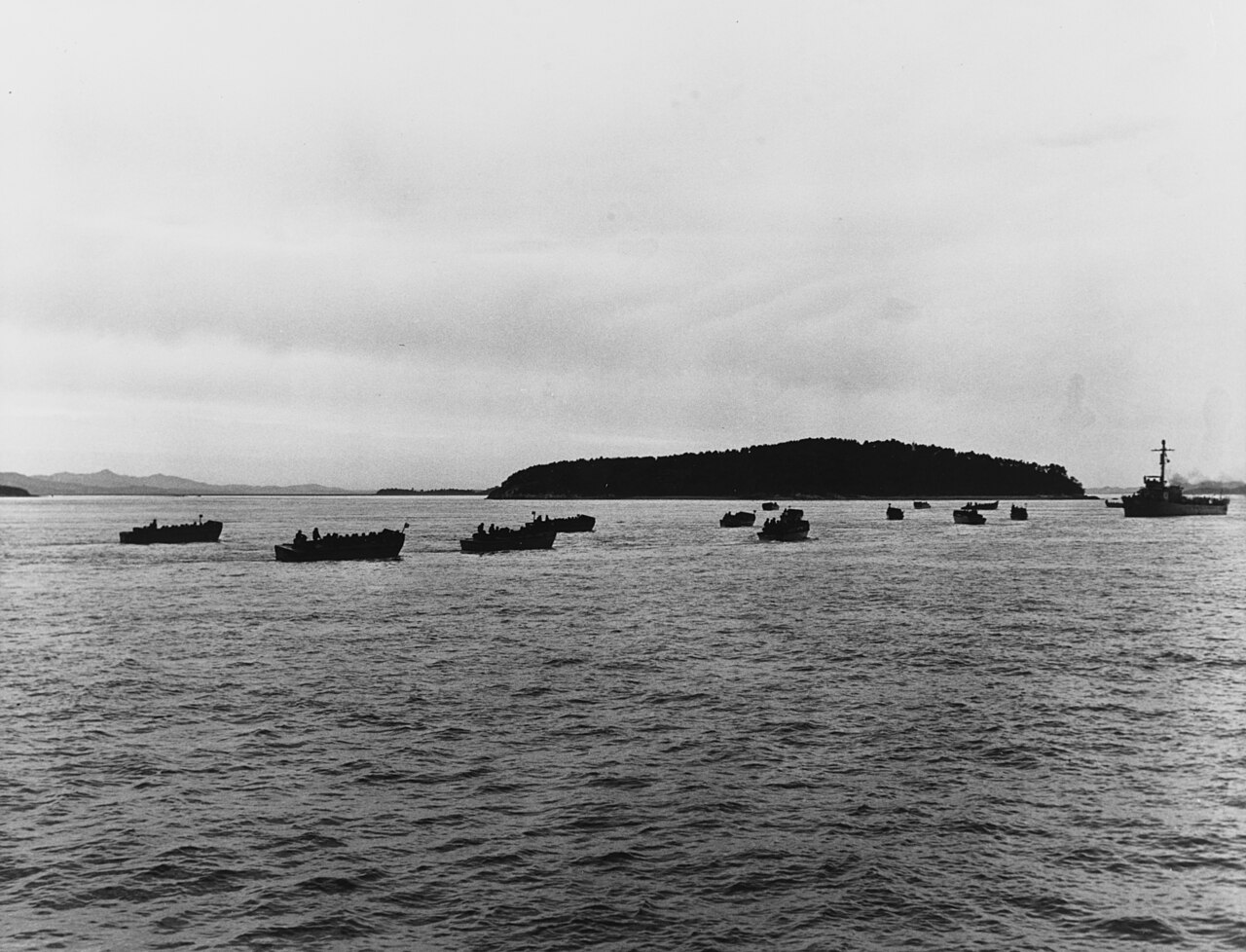
At 6:33 a.m., boats put soldiers onto Wolmi Do, a small island in Inchon Harbor joined to the city by a road. This was the Inchon Landing, an attack from ships at Inchon, a port city on the west coast of South Korea. It was part of the Korean War, a war between North Korea and South Korea. It took place on September 15, 1950.
United Nations forces, soldiers from the United States, South Korea, and other countries who fought for South Korea, were pinned down in southeast Korea. Douglas MacArthur, the American general who led them, wanted a surprise blow behind the North Korean army, the army that had invaded South Korea. He wanted Inchon so his forces could move toward Kimpo, an air base near Seoul, the capital city.
On September 13, 1950, ships and aircraft began bombing and shelling Inchon and Wolmi Do because MacArthur had won approval for a landing that could force the North Korean army to pull back or risk destruction. Wolmi Do mattered because its high ground could be used to fire on ships. The sea rose enough on September 15, 1950, so the first soldiers landed there.
Later that day, the 1st Marine Division, the large American unit trained to land from ships, attacked three beaches and quickly seized the port. The landing had been confused in places, but it had worked. On September 16, 1950, the Marines got ready to push through Inchon. The attack put United Nations forces behind the North Korean army and opened the way to retake Seoul.
This is one part of Korean War.
When
Sometime on September 15, 1950.
- What the source says
- On 15 September, 1st Marine Division assaulted three beaches and quickly seized Inchon.
- Written for the computer as
1950-09-15(Gregorian calendar, UTC; years at or below zero are BC: −0005 is 6 BC)- How sure
- exact, to the day
- Worked out by
- the Chronum server, method
edtf_gregorian_utcversion 1: the period lies within the written day
History Snippet never shows a single "best guess" date. The bar is the whole span the evidence allows; the hatched part means "somewhere in here". Why.
How we know
Took place at: The first landing was on Wolmi Do, an island in Inchon Harbor, at 6:33 a.m. on September 15, 1950, by the 5th Marine Regiment of the 1st Marine Division.
Claim status: submitted, awaiting review
- supports The Cold War's First Conflict, Section 'Amphibious End Around'
0633 on 15 September, fleet amphibious landing craft disembarked
Caused by: The tides at Inchon allowed landing craft to come in only on certain days; September 15 was the day with enough water.
Claim status: submitted, awaiting review
- supports Making the Impossible Look Easy: Operation Chromite, Section 'Operation Chromite'
15 as the only day with enough water clearance for landing craft.
Took place at: Wolmi Island was seen as the key to the whole operation because it had high ground and could be used to fire on ships.
Claim status: submitted, awaiting review
- supports Inchon, Section on the landing beaches and Wolmi-do
Wolmi Island was considered the key to the entire operation, as it offered high ground
Took place at: A photograph dated September 15, 1950 shows Marines riding amphibious tractors toward Blue Beach on Wolmi Island as the first strike of the landing.
Claim status: submitted, awaiting review
- supports Amtrac Borne members of the 1st Marine Division Attack at Inchon, Photograph description
as the first strike to secure, for United Nations forces, this vital Communist supply port.
Resulted in: After the confused landing, the 1st Marines were ready to push on through Inchon the next day, September 16, 1950.
Claim status: submitted, awaiting review
- supports Making the Impossible Look Easy: Operation Chromite, Section 'One Day Down, Many More to Go'
Despite the setbacks of the confused landing, the 1st Marines were ready to push on through Inchon the following day.
Sources disagree: Sources give different end dates for the wider Inchon operation (September 19 or September 26), but they agree the landing itself took place on September 15, 1950.
Claim status: submitted, awaiting review
Where
Inchon, South Korea
- Coordinates
- 37.4761, 126.6028 (modern map coordinates)
- Error distance
- the true spot could be up to 10,000 m from those coordinates (10.0 km)
- Today this spot lies in
- South Korea
Borders shown are today's; the record says where the place is on the modern map, not what country ruled it then.
Who and what
Pictures
Record history
Every change is a new version; older versions stay readable forever.
- Version 2 · 2026-11-14 05:22 UTC · submitted, awaiting review
published after review of the private record