
Events › French Revolution › Coup of 18 Brumaire
Coup of 18 Brumaire
Record status: submitted, awaiting review · version 2 · record history
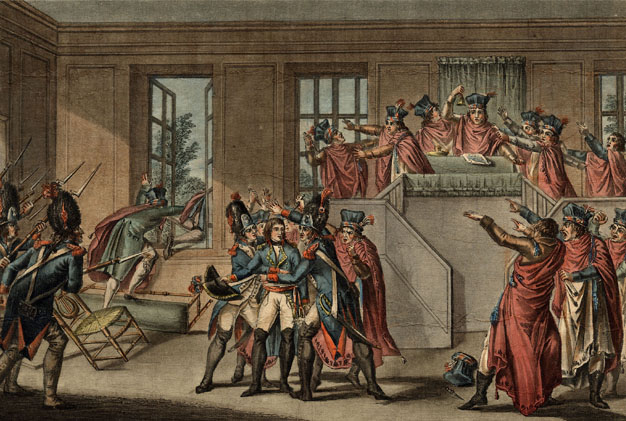
General Napoleon Bonaparte walked into a meeting hall with armed soldiers, and lawmakers refused to obey him. This was the Coup of 18 Brumaire, a sudden takeover of the French government by force and trickery. It was part of the French Revolution, a time from 1789 to 1799 when people in France overthrew their king and tried to build a new government. It happened in Paris and Saint-Cloud. It began on November 9, 1799, and ended on November 10, 1799.
Sieyès, a leader in the Directory, the weak five-man government then running France, wanted to end that government and write new rules. Bonaparte wanted to end the Revolution and put the government on steady ground under his own control. The plotters said a Jacobin plot, a threat from a radical political group, put the lawmakers in danger in Paris. Their real aim was to move the lawmakers away from the Paris crowd and place them under Bonaparte’s guard.
On November 9, 1799, the two lawmaking councils were told about that threat. Because of that warning, they voted to meet the next day at Saint-Cloud, a palace town outside Paris, and put Bonaparte in command of the troops. On November 10, 1799, Bonaparte entered the hall of the Council of Five Hundred, one of the two lawmaking councils, with armed soldiers. The members saw soldiers around them, shouted him down, and refused to change the government’s rules.
Bonaparte then called on General Murat, who led the soldiers, to seize the hall. The soldiers drove the opposing lawmakers out. Late that night, only Bonaparte’s supporters remained to vote. They ended the Directory and named three temporary consuls, the leaders who would run France, with Bonaparte at the head.
This is one part of French Revolution.
When
Began on November 9, 1799; ended on November 10, 1799.
- What the source says
- On 18 Brumaire in the year VIII (November 9, 1799)
- Written for the computer as
1799-11-09/1799-11-10(Gregorian calendar, UTC; years at or below zero are BC: −0005 is 6 BC)- How sure
- exact, to the day
- Worked out by
- the Chronum server, method
edtf_gregorian_utcversion 1: a span: started in the first written date, ended in the second
History Snippet never shows a single "best guess" date. The bar is the whole span the evidence allows; the hatched part means "somewhere in here". Why.
How we know
Began on: The coup began on 18 Brumaire, Year VIII, which is November 9, 1799, when the two councils were told of a Jacobin plot. The same source gives the whole event as November 9-10, 1799.
Claim status: submitted, awaiting review
- supports Napoleon Rises to Power in France, Opening summary
On 18 Brumaire in the year VIII (November 9, 1799), the Council of Ancients
During event: The coup nearly failed in the Orangerie. Lucien Bonaparte, who was presiding, acted quickly and prevented its collapse. Bonaparte then called on Murat to seize the Orangerie.
Claim status: submitted, awaiting review
- supports Napoleon Rises to Power in France, Main text
Only the quick action of his younger brother Lucien, who was presiding, prevented collapse of the coup.
During event: Once Bonaparte had regained his composure, he called on Murat to seize the Orangerie, and soldiers cleared the deputies out.
Claim status: submitted, awaiting review
- supports 18 Brumaire: the context and course of a coup d'État, Account of the session at Saint-Cloud
Bonaparte, who appeared to have regained his composure, called for Murat to seize the Orangerie.
Resulted in: The deputy Chazal proposed ending the Directory and creating an executive commission headed by Sieyès, Ducos and Bonaparte.
Claim status: submitted, awaiting review
- supports 18 Brumaire: the context and course of a coup d'État, Account of the evening after the Orangerie was cleared
get rid of the Directory altogether, and create an executive commission with Sieyès, Ducos, and Bonaparte at its head
Sources disagree: The sources agree on the dates and place but differ in details. The Musée des Avelines record calls the pretext a royalist plot and says Barras also resigned, while other sources say the pretext was a Jacobin plot. Sources also differ on whether the coup is dated November 9 (the plan) or November 10 (the decisive day at Saint-Cloud).
Claim status: submitted, awaiting review
Where
Paris and Saint-Cloud
- Coordinates
- 48.8500, 2.2850 (modern map coordinates)
- Error distance
- the true spot could be up to 8,000 m from those coordinates (8.0 km)
- Today this spot lies in
- France
Borders shown are today's; the record says where the place is on the modern map, not what country ruled it then.
Who and what
- personNapoleon Bonaparte
led
- personEmmanuel Joseph Sieyès
led
- personLucien Bonaparte
was there
- personJoachim Murat
was there
Pictures
Record history
Every change is a new version; older versions stay readable forever.
- Version 2 · 2026-11-12 23:32 UTC · submitted, awaiting review
published after review of the private record