
Events › French Revolution
French Revolution
Record status: submitted, awaiting review · version 10 · record history
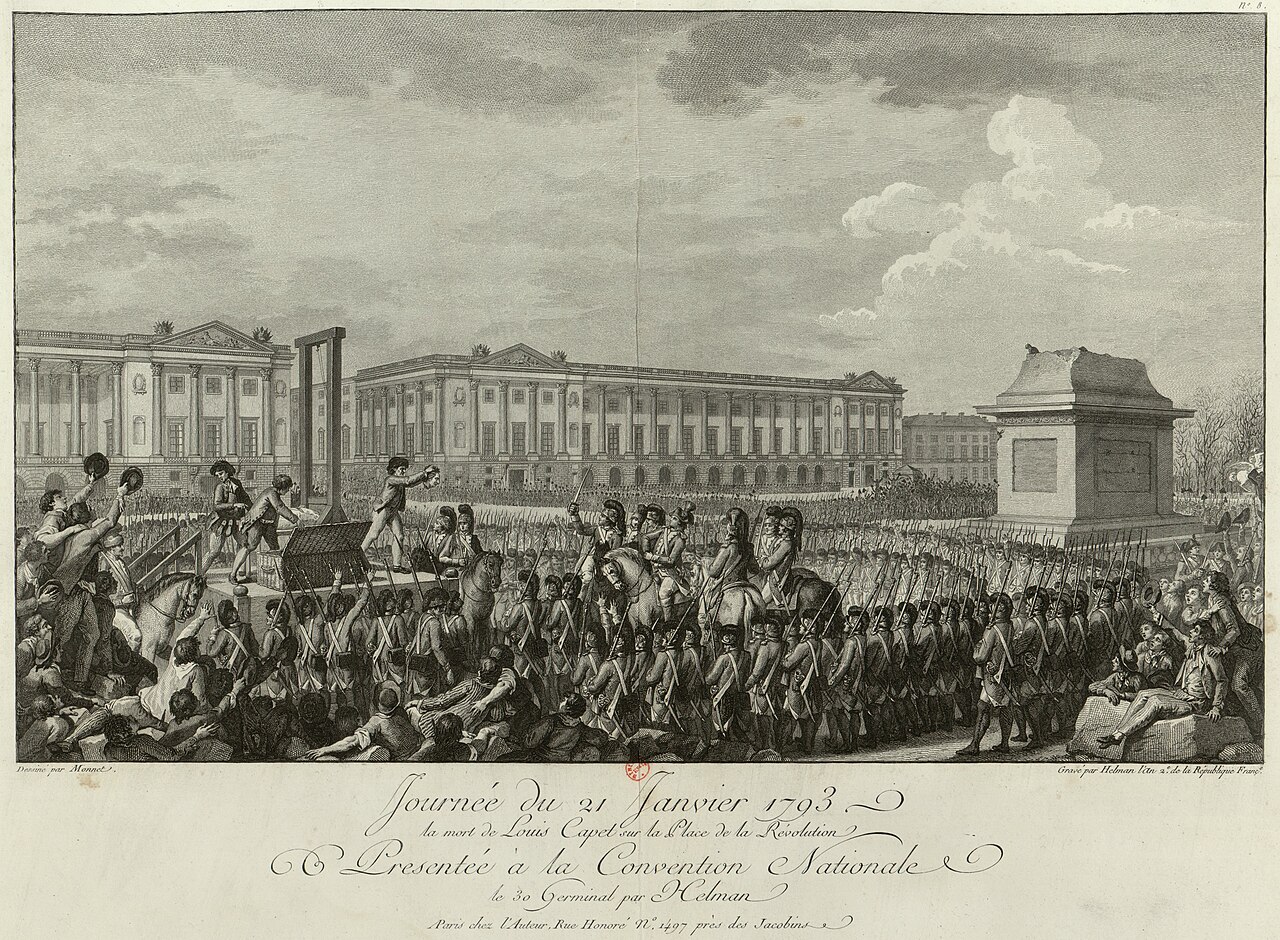
On January 21, 1793, Louis XVI, the king of France, was killed in Paris, the capital city of France, after he was found guilty of betraying his country. This was part of the French Revolution, a fight over power and the old order in France. It began in 1789 and ended in 1799.
The trouble began because France was in a financial crisis. Louis XVI called the Estates-General, an old French meeting of priests, nobles, and common people, to help deal with it. It met at Versailles, the town near Paris where the king’s great palace stood, on May 5, 1789. Many French people were angry at rich noble families with special rights and at the king’s money policies.
At the meeting, the Third Estate, the common people of France who were not priests or nobles, wanted each chosen speaker to have one vote. The two groups with special rights wanted each group to vote as one body. Because this fight grew bitter, the chosen speakers of the Third Estate declared themselves the National Assembly, a new law-making body, on June 17, 1789. They threatened to go on without the other two groups.
Rumors then spread that nobles were plotting against the people. Fear grew in Paris and in the countryside. On July 14, 1789, a Paris crowd stormed the Bastille, a stone fortress the king used as a prison, because people wanted arms to protect themselves from the king’s forces. After a wave of panic left peasants frightened, the law-makers saw one way to check them. On August 4, 1789, they ended the old system that made peasants owe payments and work to nobles, and they ended a church tax.
The Revolution broke the old order in France. It ended the king’s total power, the old land rules, and the special rights of nobles. Foreign troops later invaded France, so Maximilien Robespierre, a Revolution leader, began a time of mass executions in September 1793. On November 9, 1799, Napoleon Bonaparte, a successful young general, seized power because he wanted to end the Revolution and put the government under his control.
Inside this event
When
Began in 1789; ended on November 9, 1799.
- What the source says
- between 1787 and 1799 (Britannica); Estates-General met May 5, 1789; coup of 18 Brumaire, November 9, 1799
- Written for the computer as
1789/1799-11-09(Gregorian calendar, UTC; years at or below zero are BC: −0005 is 6 BC)- How sure
- disputed, to the year
- Worked out by
- the Chronum server, method
edtf_gregorian_utcversion 1: a span: started in the first written date, ended in the second
History Snippet never shows a single "best guess" date. The bar is the whole span the evidence allows; the hatched part means "somewhere in here". Why.
How we know
Began with: The Estates-General, the assembly of the three orders of French society, met at Versailles on May 5, 1789. Many accounts treat this meeting as the opening of the Revolution.
Claim status: submitted, awaiting review
- supports French Revolution - Estates-General, Bastille, Reforms, Events of 1789, opening paragraph
The Estates-General met at Versailles on May 5, 1789.
Key event: On July 14, 1789, the Parisian crowd stormed the Bastille, which was seen as a symbol of royal tyranny.
Claim status: submitted, awaiting review
- supports French Revolution - Estates-General, Bastille, Reforms, Events of 1789
On July 14, 1789, the Parisian crowd stormed the Bastille, a symbol of royal tyranny.
Caused by: A financial crisis led Louis XVI to call the Estates-General in 1789.
Claim status: submitted, awaiting review
- supports Timeline: Napoleon as First Consul (1799-1804), Napoleon as First Consul, introductory text
financial crises like the one which prompted Louis XVI to call the Estates General in 1789
Ended on: The coup of 18 Brumaire in November 1799 toppled the Directory, the government that then ruled France. Napoleon Bonaparte wanted to end the Revolution and put government on stable ground under his control. This page dates the coup to 18 November; the usual date is November 9.
Claim status: submitted, awaiting review
- supports Timeline: Napoleon as First Consul (1799-1804), Napoleon as First Consul, introductory text
which toppled the Directory started as a parliamentary coup and ended as a military coup
Resulted in: Louis XVI was marched to the guillotine on January 21, 1793.
Claim status: submitted, awaiting review
- supports The French Revolution, Section on the execution of the king
Louis XVI was marched to the guillotine
Caused by: The upheaval is attributed to disgust with the French aristocracy and with King Louis XVI's economic policies.
Claim status: submitted, awaiting review
- supports French Revolution: Timeline, Causes, Key Figures & Events, Introduction
The upheaval was caused by disgust with the French aristocracy and the economic policies of King Louis XVI
Began on: The Revolution began in 1789 and ended in the late 1790s when Napoleon Bonaparte rose to power.
Claim status: submitted, awaiting review
- supports French Revolution: Timeline, Causes, Key Figures & Events, Introduction
began in 1789 and ended in the late 1790s with the ascent of Napoleon Bonaparte
Sources disagree: Sources date the start differently: Britannica says 1787 (with a first climax in 1789), some count it from the Estates-General on May 5, 1789, and Wikidata uses the storming of the Bastille on July 14, 1789. They agree on 1799 for the end, though the Brown University page dates the 18 Brumaire coup to November 18 instead of the usual November 9.
Claim status: submitted, awaiting review
Where
France
- Coordinates
- 46.6000, 2.4000 (modern map coordinates)
- Error distance
- the true spot could be up to 600,000 m from those coordinates (600.0 km)
- Today this spot lies in
- France
Borders shown are today's; the record says where the place is on the modern map, not what country ruled it then.
Who and what
- personLouis Antoine de Saint-Just
was there
- personNapoleon Bonaparte
ended
- personLouis XVI
ruled during
Pictures
Record history
Every change is a new version; older versions stay readable forever.
- Version 10 · 2026-11-12 05:07 UTC · submitted, awaiting review
published after review of the private record