
Events › French Revolution › Storming of the Bastille
Storming of the Bastille
Record status: submitted, awaiting review · version 2 · record history
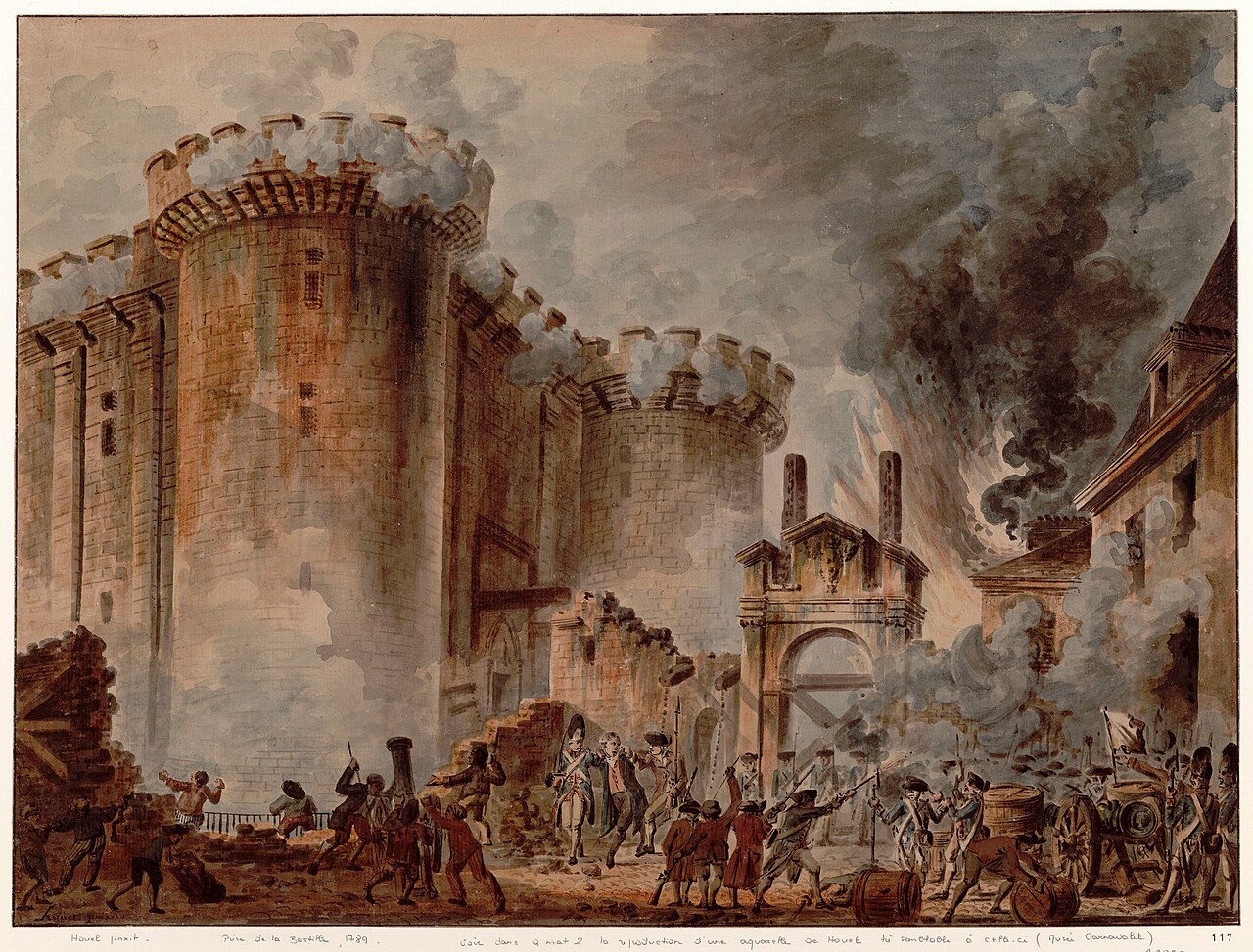
People in Paris took muskets, long guns used by soldiers, from a military hospital and turned toward the Bastille, a thick-walled prison and weapons store in Paris. This was part of the French Revolution, the years from 1789 to 1799 when the people of France overthrew the king’s old rule and changed the government. It happened on July 14, 1789.
Parisians, people who live in Paris, wanted the black powder that made their guns fire. They feared that King Louis XVI, the king of France, would use his troops to crush the National Assembly, a group trying to limit the king’s power. Many people were also hungry after poor harvests and angry at the king’s government.
Because the powder was inside the Bastille, a group came with two big guns and demanded the powder and other supplies. Bernard-René Jordan de Launay, the officer in charge of the Bastille, refused. Fighting began. Later on July 14, 1789, after he was talked out of blowing up the fortress and its powder, de Launay surrendered.
His surrender let the crowd enter. They took the powder and weapons and freed the seven prisoners inside. De Launay and some guards were killed. That evening, the Bastille’s old records were destroyed, and people began pulling the fortress down because they saw it as a sign of the king’s harsh power. Afterward, the fall of the Bastille gave the French Revolution new force, and the day later became France’s national holiday.
This is one part of French Revolution.
When
Sometime on July 14, 1789.
- What the source says
- On July 14, 1789, a crowd of Parisians stormed the Bastille, seeking arms and munitions.
- Written for the computer as
1789-07-14(Gregorian calendar, UTC; years at or below zero are BC: −0005 is 6 BC)- How sure
- exact, to the day
- Worked out by
- the Chronum server, method
edtf_gregorian_utcversion 1: the period lies within the written day
History Snippet never shows a single "best guess" date. The bar is the whole span the evidence allows; the hatched part means "somewhere in here". Why.
How we know
Began on: A crowd of Parisians stormed the Bastille on July 14, 1789, seeking arms and munitions.
Claim status: submitted, awaiting review
- supports Storming of the Bastille, Opening summary
On July 14, 1789, a crowd of Parisians stormed the Bastille, seeking arms and munitions.
Took place at: The Bastille was a royal fortress and prison in Paris, and the attack took place there.
Claim status: submitted, awaiting review
- supports This month in history: Storming of the Bastille, Opening paragraph
French revolutionaries in Paris stormed the Bastille, a royal fortress and prison.
Caused by: The Paris crowd was hungry after poor harvests and angry about its living conditions and its King and government.
Claim status: submitted, awaiting review
- supports French Revolution: The British reaction, Section 'Protest in July 1789'
hungry due to a lack of food from poor harvests, upset at the conditions of their lives
Preceded by: On the morning of July 14, thousands of Parisians raided the Invalides and took muskets. The gunpowder was stored at the Bastille.
Claim status: submitted, awaiting review
- supports La chute de la Bastille racontée en «archives» d'époque, Section 'À la recherche de poudre et de munitions'
Le matin du 14 juillet, des milliers de Parisiens pillent les Invalides et s’emparent de fusils.
Refused demand: After a detachment with cannon went to the Bastille to demand its ammunition, Governor de Launay refused.
Claim status: submitted, awaiting review
- supports This month in history: Storming of the Bastille, Section 'Who stormed the Bastille?'
The military leader of the Bastille, Governor de Launay, refused.
Resulted in: Governor Bernard-René Jordan de Launay surrendered the fortress after being talked out of blowing it up.
Claim status: submitted, awaiting review
- supports Storming of the Bastille, Summary of what happened
The governor, Bernard-René Jordan de Launay, surrendered after being dissuaded from blowing up the fortress.
Resulted in: The attackers took the arms, freed the prisoners, killed part of the garrison and executed the governor. That evening the Bastille's archives were destroyed and demolition began.
Claim status: submitted, awaiting review
- supports La chute de la Bastille racontée en «archives» d'époque, Closing section
Le soir même, les archives qu’elle contenait sont détruites, et la démolition de la citadelle commence.
Sources disagree: Sources agree on the date but not on timing and details: the surrender is placed anywhere from mid-afternoon to about 5:30 p.m., and accounts differ on where and how de Launay was killed (on the way to the city hall or at the Place de Grève).
Claim status: submitted, awaiting review
Where
Bastille, Paris
- Coordinates
- 48.8531, 2.3692 (modern map coordinates)
- Error distance
- the true spot could be up to 200 m from those coordinates
- Today this spot lies in
- France
Borders shown are today's; the record says where the place is on the modern map, not what country ruled it then.
Who and what
Pictures
Record history
Every change is a new version; older versions stay readable forever.
- Version 2 · 2026-11-12 22:52 UTC · submitted, awaiting review
published after review of the private record