
Events › French Revolution › The Third Estate Declares Itself the National Assembly
The Third Estate Declares Itself the National Assembly
Record status: submitted, awaiting review · version 2 · record history
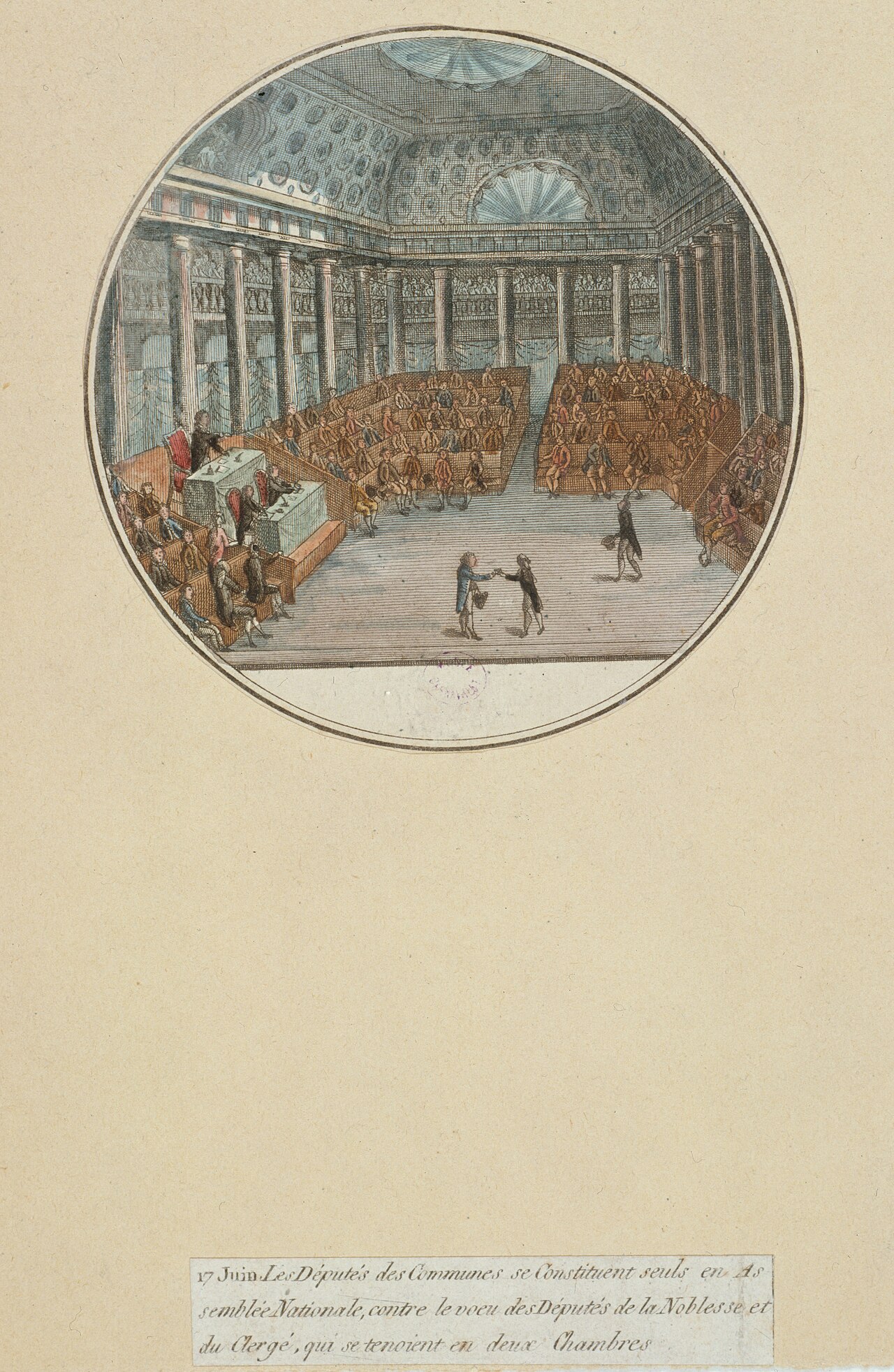
The Third Estate, the group of ordinary French people who were not priests or nobles, gave itself a new name and claimed to speak for France. This happened during the French Revolution, a time starting in 1789 when people in France fought to end the king’s absolute power and change the government. It happened at the Hôtel des Menus-Plaisirs, a large meeting building in Versailles, a town near Paris. It happened on June 17, 1789.
The struggle began when the Estates-General, a large meeting of representatives of France’s three groups, met at Versailles on May 5, 1789. Its members split over voting. The Third Estate wanted vote by head, where every person gets one vote, because it had the most people. The priests and high-born people with special rights wanted vote by estate, where each group gets one vote, because their two groups could beat the Third Estate.
On June 10, 1789, Emmanuel-Joseph Sieyès, a priest and representative of the Third Estate, proposed a plan. The Third Estate would invite the other two groups to join it, and a list of all members would be read. The Third Estate wanted to force all three groups to meet and vote as one body.
The bitter fight over voting drove the Third Estate representatives to act. On June 17, 1789, with a few priests and high-born people, they declared themselves the National Assembly, a new body claiming to speak for the whole nation. They threatened to carry on without the other two groups if necessary. On June 27, 1789, the king ordered the priests and high-born people to join them. Afterward, the old meeting of separate groups had been replaced by one body speaking for France.
This is one part of French Revolution.
When
Sometime on June 17, 1789.
- What the source says
- On June 17, after considerable debate, the Third Estate assumed the name National Assembly.
- Written for the computer as
1789-06-17(Gregorian calendar, UTC; years at or below zero are BC: −0005 is 6 BC)- How sure
- exact, to the day
- Worked out by
- the Chronum server, method
edtf_gregorian_utcversion 1: the period lies within the written day
History Snippet never shows a single "best guess" date. The bar is the whole span the evidence allows; the hatched part means "somewhere in here". Why.
How we know
Began on: On June 17, 1789, after considerable debate, the Third Estate took the name National Assembly.
Claim status: submitted, awaiting review
- supports Oath of the Tennis Court, Background section on the events of June 1789
On June 17, after considerable debate, the Third Estate assumed the name National Assembly.
Caused by: The Estates-General was split over whether to vote by head, which favored the Third Estate, or by estate, which favored the two privileged orders. The struggle drove the deputies to act.
Claim status: submitted, awaiting review
- supports French Revolution - Estates-General, Bastille, Reforms, Events of 1789, opening paragraph
should they vote by head, giving the advantage to the Third Estate, or by estate
Declared intent: In declaring themselves the National Assembly, the deputies threatened to go ahead without the other two orders if they had to.
Claim status: submitted, awaiting review
- supports French Revolution - Estates-General, Bastille, Reforms, Events of 1789, opening paragraph
they threatened to proceed, if necessary, without the other two orders.
Proposed by: The Third Estate accepted a proposal by the delegate Abbé Sieyès and proclaimed itself the National Assembly.
Claim status: submitted, awaiting review
- supports French Revolution chronology, Chronology, May 5 to July 17, 1789 section, entry for June 17
Accepting the proposition of the delegate Abbe Sieyes, the Third Estate proclaims itself The National Assembly.
Took place at: The Estates-General met in the Hôtel des Menus-Plaisirs at Versailles. The same page says the Parliamentary Assembly became the National Assembly on June 17.
Claim status: submitted, awaiting review
- supports The Hôtel des Menus-Plaisirs, The premises under the French Revolution
became the venue for the Parliamentary Assembly.
Participated in: Some members of the Nobility and the Clergy joined the Third Estate deputies in forming the National Assembly.
Claim status: submitted, awaiting review
- supports Versailles at the heart of the French Revolution, Anecdote box, 17 June 1789
the deputies of the Third Estate, together with some members of the Nobility and the Clergy,
Resulted in: The king had the Third Estate's meeting hall closed. Britannica dates the lockout of the deputies to June 20, and the Château de Versailles says the king shut the hall immediately after June 17.
Claim status: submitted, awaiting review
- supports French Revolution chronology, Chronology, entry for June 20
The king orders the meeting hall of the Third Estate closed.
Sources disagree: Sources differ on when the deputies lost their hall: the Château de Versailles says the king shut it immediately after June 17, while Britannica says the deputies were locked out on June 20. Other web pages also give different vote tallies for June 17 (490 to 90 and 491 to 89).
Claim status: submitted, awaiting review
Where
Hôtel des Menus-Plaisirs, Versailles
- Coordinates
- 48.8047, 2.1288 (modern map coordinates)
- Error distance
- the true spot could be up to 200 m from those coordinates
- Today this spot lies in
- France
Borders shown are today's; the record says where the place is on the modern map, not what country ruled it then.
Who and what
- personEmmanuel-Joseph Sieyès
led
- personLouis XVI
ruled during
Pictures
Record history
Every change is a new version; older versions stay readable forever.
- Version 2 · 2026-11-12 14:24 UTC · submitted, awaiting review
published after review of the private record