
Events › Iranian Revolution
Iranian Revolution
Record status: submitted, awaiting review · version 2 · record history
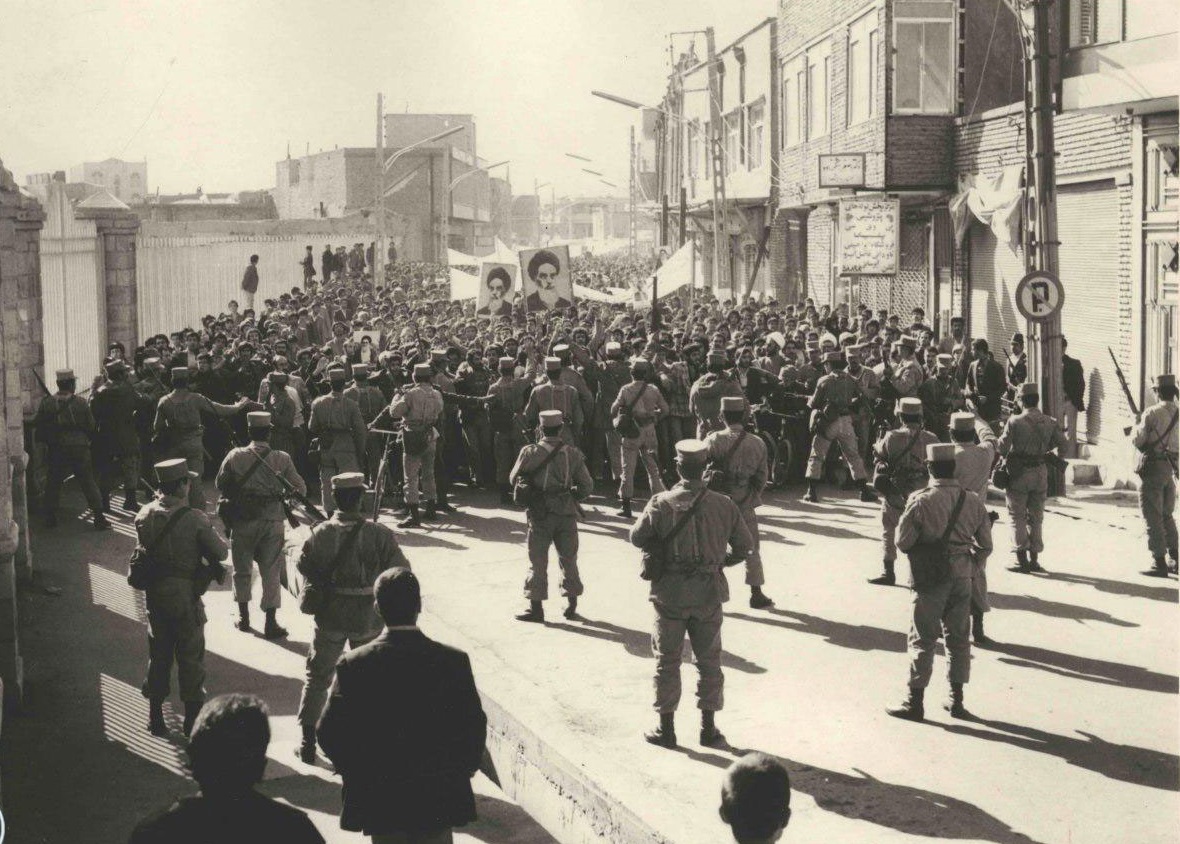
Millions of Iranians marched across the country. They demanded that the Shah, the title of the king of Iran, be removed. They also demanded the return of Khomeini, an Iranian Muslim religious leader who opposed the Shah from outside Iran. This event was the Iranian Revolution in Iran. It began in January 1978 and ended on February 11, 1979.
Many Iranians were angry at the Shah. He ruled with total power and did not need the people’s agreement. They saw his rule as corrupt. They also thought he ran the economy badly. Many people disliked the strong pull of Western culture in Iran. People who wanted change wanted to replace the monarchy, a system in which a king or queen rules, with an Islamic government under Khomeini.
In January 1978, protests broke out in Qom, a holy city in Iran and a center of Muslim study. This happened because government press attacks on Khomeini angered his supporters. Later in 1978, millions of Iranians protested across the country. They were angry at the Shah’s rule, corruption, and bad handling of the economy. So they demanded that the Shah be removed and that Khomeini return.
In December 1978, the army mutinied, which means soldiers refused to obey their commanders. The Shah then named Shapour Bakhtiar, a leader who opposed him, as the head of the government under the king. The army had mutinied. The protests demanding the Shah’s removal had not stopped. So the Shah and his family left Iran for Egypt on January 16, 1979.
The Shah had left two weeks earlier. People who wanted change wanted an Islamic government under Khomeini. So Khomeini returned to Tehran, the capital city of Iran, on February 1, 1979, and millions greeted him. On February 11, 1979, the army’s top commanders ordered troops back to the buildings where soldiers live. Armed revolutionary groups took over army sites. Afterward, Iran’s monarchy, which had lasted about 2,500 years, was overthrown. Iran became an Islamic republic, a country governed under Islamic law and led by religious leaders, with Khomeini as its leader.
Inside this event
When
Began in January 1978; ended on February 11, 1979.
- What the source says
- The active phase of the Iranian Revolution began in January, 1978 (EBSCO); Iranica: February 11, 1979, the Army's Supreme Council orders the troops back to their barracks.
- Written for the computer as
1978-01/1979-02-11(Gregorian calendar, UTC; years at or below zero are BC: −0005 is 6 BC)- How sure
- approximate, to the month
- Worked out by
- the Chronum server, method
edtf_gregorian_utcversion 1: a span: started in the first written date, ended in the second
History Snippet never shows a single "best guess" date. The bar is the whole span the evidence allows; the hatched part means "somewhere in here". Why.
How we know
Began on: The active phase of the revolution began in January 1978, when government press attacks on Khomeini led to mass protests in the holy city of Qom.
Claim status: submitted, awaiting review
- supports Iranian Revolution, Overview, paragraph on the active phase
government press attacks on Khomeini led to mass protests in the holy city of Qom
Caused by: The revolution was fueled by widespread discontent with the Shah's autocratic regime, including economic mismanagement, corruption and heavy Western cultural influence.
Claim status: submitted, awaiting review
- supports Iranian Revolution, Overview
fueled by widespread discontent with the shah's autocratic regime, characterized by economic mismanagement, corruption
Shah left iran on: On January 16, 1979, the Shah and his family left Iran for Egypt, officially for a vacation.
Claim status: submitted, awaiting review
- supports The Iranian revolution—A timeline of events, Timeline, January 1979 entry
Shah and his family leave Iran for Egypt
Khomeini returned on: On February 1, 1979, Khomeini returned to Iran and was greeted by millions of people in the streets of Tehran.
Claim status: submitted, awaiting review
- supports The Iranian revolution—A timeline of events, Timeline, February 1 entry
Khomeini returns to Iran and is greeted by millions of people in the streets of Tehran
Ended on: On February 11, 1979, the army's Supreme Council ordered troops back to their barracks, and revolutionary militias occupied military installations and arrested army commanders.
Claim status: submitted, awaiting review
- supports Chronology of Iranian History Part 4, 1979 entries, February 11
Military installations are occupied by revolutionary militia of various groups and army commanders are arrested.
Resulted in: On March 30–31, 1979, a nationwide referendum approved the establishment of an Islamic Republic.
Claim status: submitted, awaiting review
- supports Chronology of Iranian History Part 4, 1979 entries, March 30-31
The establishment of an Islamic Republic is approved in a nationwide referendum.
Army mutinied and shah fled: The army mutinied in December 1978, and the Shah fled on January 16, 1979.
Claim status: submitted, awaiting review
- supports Ayatollah Khomeini returns to Iran, Main text, second paragraph
In December, the army mutinied, and on January 16, 1979, the shah fled.
Sources disagree: The sources give different end points: one encyclopedia dates the revolution to 1978–1980, while the chronology used here places the fall of the old government on February 11, 1979, and some accounts mark the Islamic Republic's declaration on April 1, 1979.
Claim status: submitted, awaiting review
Where
Iran
- Coordinates
- 32.0000, 53.0000 (modern map coordinates)
- Error distance
- the true spot could be up to 1,000,000 m from those coordinates (1,000.0 km)
- Today this spot lies in
- Iran
Borders shown are today's; the record says where the place is on the modern map, not what country ruled it then.
Who and what
- personMohammad Reza Pahlavi
ruled during
- personRuhollah Khomeini
led
- personShapour Bakhtiar
was there
Pictures
Record history
Every change is a new version; older versions stay readable forever.
- Version 2 · 2026-11-20 15:32 UTC · submitted, awaiting review
published after review of the private record