
Events › Iranian Revolution › Tasua and Ashura marches in Tehran
Tasua and Ashura marches in Tehran
Record status: submitted, awaiting review · version 3 · record history
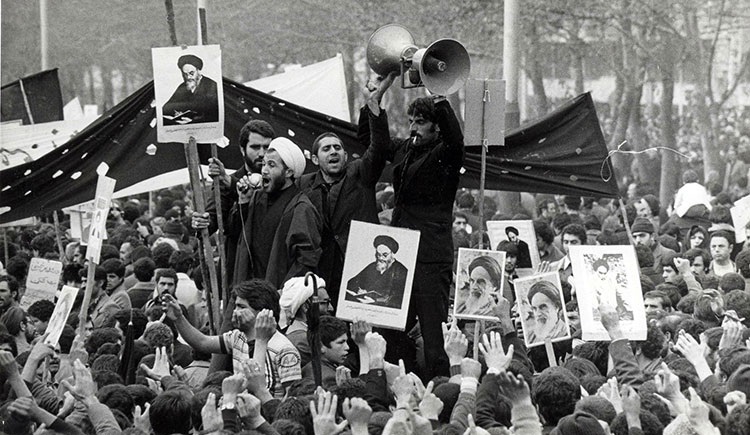
More than two million marchers in Tehran approved a demand for Khomeini to lead Iran. These marches were part of the Iranian Revolution, the uprising in Iran from January 1978 to February 11, 1979 that overthrew the Shah. They happened in Tehran, the capital city of Iran. The marches began and ended in December 1978.
Many Iranians wanted the Shah, the king of Iran, gone. They wanted Khomeini, a religious leader from Shia Islam, one of the two main branches of Islam, to lead them. On November 6, 1978, the Shah put army officers in charge of the government because he wanted to stop the worst anti-government violence Tehran had seen in 15 years. Khomeini said the Shah’s promises were worthless, so he called for protests to continue.
The Muslim month of Muharram, a time of mourning for Shia Muslims, gave the protests great weight. Because Khomeini’s side called opposition to army rule a religious duty, vast demonstrations began as soon as Muharram started. On the ninth day of Muharram, about December 10, 1978, about a million people marched in Tehran demanding the end of rule by a king. On Ashura, the tenth day of Muharram, about December 11, 1978, more than two million marchers approved a demand for a government led by Khomeini.
The marches ended in December 1978. They showed how many people opposed the Shah and wanted Khomeini to return. During that same month, the Shah began talks with some opponents who wanted change through politics.
This is one part of Iranian Revolution.
When
Sometime in December 1978.
- What the source says
- On Dec. 11, 1978, one of the largest demonstrations against the Shah took place in Tehran.
- Written for the computer as
1978-12(Gregorian calendar, UTC; years at or below zero are BC: −0005 is 6 BC)- How sure
- approximate, to the month
- Worked out by
- the Chronum server, method
edtf_gregorian_utcversion 1: the period lies within the written month
History Snippet never shows a single "best guess" date. The bar is the whole span the evidence allows; the hatched part means "somewhere in here". Why.
How we know
Attendance estimate low: The Library of Congress country study dates the marches to December 9 and 10, 1978, and says several hundred thousand people marched in Tehran and the provinces.
Claim status: submitted, awaiting review
- supports Iran - The Coming of the Revolution, The Coming of the Revolution, paragraph on December 1978
several hundred thousand persons participated in marches in Tehran and the provinces
Attendance tasua: On the ninth day of Muharram (Tasua), a million people marched in Tehran demanding the overthrow of the monarchy.
Claim status: submitted, awaiting review
- supports The Islamic Revolution, 1978-79 (in Imam Khomeini: A Short Biography), Section on Muharram demonstrations
On Muharram 9, a million people marched in Tehran demanding the overthrow of the monarchy
Resulted in: On Ashura, more than two million marchers approved a seventeen-point declaration, whose chief demand was an Islamic government headed by Khomeini.
Claim status: submitted, awaiting review
- supports The Islamic Revolution, 1978-79 (in Imam Khomeini: A Short Biography), Section on Muharram demonstrations
more than two million demonstrators approved by acclamation a seventeen-point declaration
Began on: One of the largest demonstrations against the Shah took place in Tehran on December 11, 1978, the day of Ashura.
Claim status: submitted, awaiting review
- supports Unintended Consequences, Opening paragraphs of the excerpt
On Dec. 11, 1978, one of the largest demonstrations against the Shah took place in Tehran.
Caused by: The Shah named the armed forces commander prime minister to lead a military government on November 6, 1978, to quell the worst anti-government violence in Tehran in 15 years.
Claim status: submitted, awaiting review
- supports Iran forms military government, First paragraph
named Iran's armed forces commander as prime minister and asked him to form a military government
Demand: The marchers demanded that the Shah be removed and that Khomeini return. This source puts the Ashura Day march in Tehran on December 11, 1978, and claims up to 17 million marchers across Iran.
Claim status: submitted, awaiting review
- supports Forty Years of the Iranian Revolution: 'The Shah is Gone', Photo caption and opening paragraph
marched peacefully to demand the removal of the Shah and the return of Ayatollah Khomeini
Caused by: Khomeini rejected the Shah's promises as worthless and called for the protests to continue, which led to the Muharram marches.
Claim status: submitted, awaiting review
- supports Iran - The Coming of the Revolution, The Coming of the Revolution, paragraph on the military government
Khomeini dismissed the shah's promises as worthless, however, and called for continued protests.
Sources disagree: Sources differ on the days (December 9 and 10 versus December 10 and 11, 1978) and on the crowd size, from several hundred thousand to millions, with one claiming up to 17 million across Iran.
Claim status: submitted, awaiting review
Where
Tehran, Iran
- Coordinates
- 35.6892, 51.3890 (modern map coordinates)
- Error distance
- the true spot could be up to 15,000 m from those coordinates (15.0 km)
- Today this spot lies in
- Iran
Borders shown are today's; the record says where the place is on the modern map, not what country ruled it then.
Who and what
- personRuhollah Khomeini
led
- personMohammad Reza Pahlavi
ruled during
Pictures
Record history
Every change is a new version; older versions stay readable forever.
- Version 3 · 2026-11-20 18:31 UTC · submitted, awaiting review
published after review of the private record